Monday, June 23, 2008

Scalia: A legend in his own mind

In his dissenting opinion in Boumediene v. Bush, which conferred the right of judicial review on detainees at Guantanamo and elsewhere, Antonin Scalia flatly declared:
The game of bait-and-switch that today’s opinion plays upon the Nation’s Commander in Chief will make the war harder on us. It will almost certainly cause more Americans to be killed.
In support of this contention, he claims:
In the short term... the [majority's] decision is devastating. At least 30 of those prisoners hitherto released from Guantanamo Bay have returned to the battlefield.
He goes on to cite several incidents from the GWOT "battlefield" a very flexible concept for Scalia as alleged in such sources as the minority report of a Senate committee and several articles from WaPo. Most of the alleged incidents occurred in 2004.

Mark Denbeaux, a professor at Seton Hall University School of Law (SHUSL), with the assistance of several law students, deconstructed Scalia's claims in a detailed 22-page report that found:
"Justice Scalia’s reliance on the these sources would have been more justifiable had the urban legend he perpetuated not been (one would have thought) permanently interred by later developments, including a 2007 Department of Defense Press Release and hearings before the House Foreign Relations Committee less than two weeks before Justice Scalia’s dissent was released.

[...]

"Justice Scalia’s claim of 30 recidivist detainees is belied by all reliable data. Such a statement simply repeats, without appropriate judicial analysis or skepticism towards the statements of parties before the Court, inaccurate data disseminated by the Department of Defense. Despite being repeatedly debunked, this statement has been reflexively accepted as true by Members of Congress and much of the American public. Justice Scalia is only the most recent disseminator of an urban legend that refuses to die."
The SHULS study found that only one released Gitmo detainee (designated "ISN 220") later took up arms against U.S. forces or their allies, and he was not released as a result of any legal process. In fact, the report found that "the decision to release ISN 220 was made by political officers in the Department of Defense and was contrary to the recommendations of the military officers."

Scalia's false claims go to the heart of the rationale for holding detainees without judicial review: if any doubt exists, keep them locked up indefinitely for fear that they might attack the U.S. or its allies [1]. This falsehood will be repeated many times by October 8th, when the first Gitmo trial begins.

Scalia's dissent is yet another variant of the Willie Horton Syndrome (see below and here) in U.S. politics. No politician or member of SCOTUS wants to be blamed for the release of a prisoner who later attacks U.S. troops or civilians. While this impulse may be understandable, an opaque system that includes torture and indefinite detentions is not the solution. A transparent judicial process is better able to balance legitimate security considerations with the due-process rights of those who have been unfairly accused and imprisoned.


NOTES

[1] Unless there's enough international pressure to force their release, of course.

[H/T to Scott Lemieux at Lawyers, Guns and Money
and M. Duss at Think Progress]

Friday, June 20, 2008

Blues Break: Two by Blind Willie Johnson


Dark was the Night, Cold was the Ground

A great "moaning" piece by Blind Willie Johnson (1897-1945), born in Brenham, Texas. This song is one of the tracks on NASA's Voyager Golden Record. Launched in 1977, Voyager left the outer limits of the solar system in 2004.

Trouble Soon Be Over
Performed with a wonderful young singer whose name isn't available.

Saturday, June 07, 2008

McCain on Vietnam (but not Iraq)

In his 2001 foreword to the late David Halberstam's The Best and the Brightest, John McCain wrote the following about the war in Vietnam:
"It was a shameful thing to ask men to suffer and die, to persevere through god-awful afflictions and heartache, to endure the dehumanizing experiences that are unavoidable in combat, for a cause that the country wouldn’t support over time and that our leaders so wrongly believed could be achieved at a smaller cost than our enemy was prepared to make us pay. No other national endeavor requires as much unshakable resolve as war. If the nation and the government lack that resolve, it is criminal to expect men in the field to carry it alone...

"For anyone who aspires to a position of national leadership, no matter the circumstances of his or her birth, this book should be mandatory reading. And anyone who feels a need, as a confused former prisoner of war once felt the need, for insights into how a great and good nation can lose a war and see its worthy purposes and principles destroyed by self-delusion can do no better than to read and reread David Halberstam’s The Best and the Brightest."
Yet this is the same candidate who has declared victory in Iraq, some five years (or 10.0 Friedman Units) in advance. And if that doesn't work, he'd embrace a whole century of U.S. occupation. Go figure.

But there's a deeper consistency here. McCain, after all, has complained that the U.S. didn't "fight to win" in Vietnam due to a lack of political will. This lack of "unshakable resolve," in turn, resulted from the failure of the civilian political leadership to rally support on the home front. Responsibility falls most heavily on liberal politicians in Washington, notably LBJ and Robert McNamara, and the antiwar movement.

McCain invokes the central tenet of right-wing mythologies about the Vietnam war: The troops were defeated at home, not on the battlefield. The various military outcomes over a dozen years may be debatable, but in this view the blame falls squarely on the civilian leadership and lack of popular support at home. Never mind that military successes are meaningless unless they achieve the political goals that are used to justify a war.*

The lack of "unshakable resolve" is McCain's variant on the infamous Dolchstoßlegende, or "stabbed in the back legend," from World War I. By that account, Germany lost the war due to the lack of will and duplicity of its politicians rather than any failures on the battlefield. Hitler later blamed the "November criminals" of 1918 including German Jews and the socialists who agitated against the war for Germany's betrayal. The Rambo series is a Hollywood version of the same mythology, which will certainly be resurrected by the right to account for failure in Iraq.

The fundamental problem, in this right-wing fantasy, is sheer lack of will as if "will" is a pure abstraction, a unique virtue unrelated to the actual political motives that caused the U.S. to wage war in Vietnam and Iraq. It seems this flawed ideology of "will," the legacy of two world wars and Vietnam, is very resilient.

For McCain, "unshakable resolve" magically assures success in war. But the deeper issue is always: resolve to do what, exactly? If the end is morally flawed or morally ambiguous, the war is unlikely to generate "unshakable resolve" on the home front and within the military itself. Tactical successes in combat become irrelevant or even, as in Iraq, counterproductive. High casualties, for no defensible purpose, combine with the slaughter of civilians to undermine any initial "resolve" that an invasion may have generated.

Colonel Kurtz aptly describes McCain's version of "will" in Apocalypse Now:
"You have to have men who are moral... and at the same time who are able to utilize their primordial instincts to kill without feeling... without passion... without judgment... without judgment. Because it's judgment that defeats us."
If there's anything that describes McCain's policies on Iraq and the Middle East, it's that one simple phrase: "without judgment..."

NOTES

* The far right likes to think that the U.S. was never "defeated" militarily in Vietnam (or in Iraq for that matter). The Tet offensive of 1968 is often invoked as proof of that claim. While it's true that the Vietcong and North Vietnamese were unable to hold many of their initial objectives, it can't be denied that Tet was an enormous political victory for their forces. Contrary to the Johnson administration's specious claims, Tet demonstrated that the insurgency, and not the U.S., held the strategic initiative in the war.

[H/T tip to The Cunning Realist and Digby]

Saturday, May 24, 2008

Blues Break: Shamisen with taiko


Virtuoso performances on the 3-stringed shamisen and taiko accompaniment. From Japanese television, but sadly the names of the performers and date are not available.

Sunday, May 04, 2008

Missing from the cable news loops


Here's the Reverend John Hagee, the bigot whose endorsement was sought and welcomed by John McCain earlier this year.

In a recent interview on NPR's Fresh Air, Hagee shared his thoughts on divine retribution:
"I believe that the Hurricane Katrina was, in fact, the judgment of God against the city of New Orleans...I believe that New Orleans had a level of sin that was offensive to God, and they are -- were recipients of the judgment of God for that...There was to be a homosexual parade there on the Monday that the Katrina came. And the promise of that parade was that it was going to reach a level of sexuality never demonstrated before in any of the other Gay Pride parades.... The Bible teaches that when you violate the law of God, that God brings punishment sometimes before the day of judgment."
Back in 2006, Hagee succumbed to pangs of nostalgia for the good old days of slavery:
To help students seeking odd jobs, his church newsletter, The Cluster, advertised a "slave" sale. "Slavery in America is returning to Cornerstone," it said. "Make plans to come and go home with a slave." Mr. Hagee apologized but, in a radio interview, protested about pressure to be "politically correct" and joked that perhaps his pet dog should be called a "canine American."
McCain has lately distanced himself from Hagee's most extreme anti-Catholic remarks. A campaign lackey stated:
"While we welcome [Hagee's] support, it shouldn't be seen as a wholesale endorsement of all of Mr. Hagee's views."
Barack Obama has gone a lot further in renouncing Reverend Jeremiah Wright's most inflammatory rhetoric. Yet we don't see CNN or Fox endlessly looping the many outrageous videos of Hagee on subjects as diverse as homosexuality, eschatology and a Christian jihad against Iran. Jerry Falwell, Pat Robertson and other (in the words McCain once used) "agents of intolerance" also get a free ride. As Frank Rich writes in today's NYT:
Even after Mr. Hagee’s Catholic bashing bubbled up in the mainstream media, Mr. McCain still did not reject and denounce him, as Mr. Obama did an unsolicited endorser, Louis Farrakhan, at the urging the urging of Tim Russert and Hillary Clinton. Mr. McCain instead told George Stephanopoulos two Sundays ago that while he condemns any “anti-anything” remarks by Mr. Hagee, he is still “glad to have his endorsement.”

I wonder if Mr. McCain would have given the same answer had Mr. Stephanopoulos confronted him with the graphic video of the pastor in full “Great Whore” glory. But Mr. McCain didn’t have to fear so rude a transgression. Mr. Hagee’s videos have never had the same circulation on television as Mr. Wright’s. A sonorous white preacher spouting venom just doesn’t have the telegenic zing of a theatrical black man.

In case there's any question, here's how a President McCain's religious views will influence his political appointments (hint: Jews, Muslims, Buddhists, atheists, Catholics and non-Baptist Christians need not apply):


Friday, May 02, 2008

Update: 71% and counting

Here's an update on our related blog entry for April 24th:
A CNN/Opinion Research Corp. survey released Thursday indicates that 71 percent of the American public disapprove of how Bush is handling his job as president.

"No president has ever had a higher disapproval rating in any CNN or Gallup Poll; in fact, this is the first time that any president's disapproval rating has cracked the 70 percent mark," said Keating Holland, CNN's polling director.

Sunday, April 27, 2008

Sunday trail blogging: Larch Mountain, Oregon Cascades


During the summer and fall, the 4,000-ft. summit of Larch Mountain is easily accessible by road from Portland. In the winter and spring, it's an altogether different experience: skis or snowshoes are required. If the snow level is low, as it is now, a very long trek (6 miles or more, one way) may be required. The reward is an expansive view from the summit pinnacle, including Mt. Hood (above) to the east, the Columbia Gorge and the Washington Cascades to the north and the Willamette Valley and Portland (below) to the west. Skiers can finish the day with a glorious downhill run through dense forest that, on rare occasions, opens onto fresh clearcuts. [Warning: the road is open to snowmobiles and other off-road vehicles, but so far I've been lucky enough to avoid them.]


PHOTOS: M.J. O'Brien

Pique of the week: Road signs

The two-lane country road that links my Oregon town to the nearest freeway is lined with 73 traffic signs over its 10-mile length. Some of the signs are clearly indispensable, including such standbys as Stop, Entering School Zone, several speed-limit signs and a few directional signs. But most of the signs are so obvious and redundant as to be worthless. Is it really necessary, for example, to have No Passing signs when there's already a double yellow line clearly painted on the pavement? By my reckoning (and I'm admittedly not a traffic engineer), at least two-thirds of those 73 signs could be removed without endangering or even confusing anyone.

The result of all the unneeded road signs is visual clutter that is distracting, ugly and, quite possibly, unsafe. The safety concerns have been reinforced by a "Shared Space" study that was recently conducted across the Atlantic:
"The experiment, funded by the European Union, began in 2004 in seven villages, towns and municipalities in Denmark, Britain, Belgium and the Netherlands. One Dutch town, admittedly tiny with a population of 1,000, has not only taken down stop signs and directional signs but has yanked its parking meters and scraped off the lines on its streets.

"While the experiment has generally been tried in areas of smaller populations, the city of London conducted a similar experiment on one of its most crowded shopping streets - and saw a 40 percent reduction in accidents. In response, the city next will yank out traffic signals on a main street in its busy museum district."

Traffic signals work best, it seems, when they're separated by at least a quarter mile--a principle often violated in U.S. towns and cities.

The Shared Space innovations have attracted considerable attention around the world. Maybe similar experiments could be conducted here, although we have a long history of government paternalism in regulating our highways. In brief, transportation planners assume that drivers in the U.S. are complete dolts. The Shared Space designers took a different approach:

"The theory behind the philosophy: Drivers will speed, run yellow lights and generally drive like idiots when they think they are protected from the consequences of their actions because they assume other drivers will follow the rules.

"Throwing in a little anarchy sharpens drivers' senses, say advocates of the Shared Space philosophy.

"Or, as the German magazine Spiegel put it in a story on the experiment: 'Where the situation is unclear, they're forced to drive more carefully and cautiously.'"

The goal of the Shared Space experiment is paradoxical:
"The assumption is that drivers are accustomed to owning the road and rarely pay attention to speed limits or caution signs anyway. Removing traffic lights and erasing lane markers, the thinking goes, will cause drivers to get nervous and slow down.

"'Generally speaking, what we want is for people to be confused,' said Willi Ladner, a deputy mayor in Bohmte [Germany]. 'When they're confused, they'll be more alert and drive more carefully.'"

The benefits of the Shared Space approach may extend beyond the streets and highways:
"There is another underlying assumption to Shared Space: Without signs and signals telling motorists what to do, they will revert to the courtesy and good manners they show in other parts of their life. That means watching and adapting to the movements of other drivers and peering into the eyes of pedestrians and bicyclists to reach some unspoken accommodation with others on the road."
It's easy to imagine nightmare scenarios in the U.S. involving drivers on cellphones without traffic signs to guide or inhibit them. But the experiment hasn't produced mayhem in Europe. Quite the contrary: accident rates have fallen dramatically in most locations.

So and it may be worth a try here. To date only West Palm Beach, Florida, has undertaken a similar approach to traffic signs.

In many communities across the U.S., on the other hand, New Urbanist designs (like "skinny streets") have successfully achieved traffic calming in neighborhoods and reduced the aesthetic impacts of an autocentric culture. But traffic engineers, by and large, remain convinced that the principal goal of a street or highway is to move vehicles as efficiently as possible from point A to point B.

The local 10-mile freeway connection was upgraded a couple years ago by the addition of two roundabouts at a couple dangerous intersections. The traffic flow has slowed considerably, reducing accidents and making them less harmful when they do occur.

But the number of road signs, alas, hasn't changed. They're just a small part, easily overlooked, of the aesthetic nightmare that the built landscape of the U.S. has become.


PHOTO: Traffic-light sculpture in the U.K.

Blues Break: NIN - "Discipline"


A change of pace: this single was released for free by Nine Inch Nails on April 22nd. This "video" consists of just a few still photos. Ghosts, Trent Reznor's instrumental album, was released last month.

Thursday, April 24, 2008

A record high (but not the Dow)

According to the latest Gallup poll (April 18-20), George W. Bush has received the highest disapproval ratings of any president in the 70-year history of the organization. Fully 69% of those who responded disapproved of his performance, while 28% approved. Fewer than 4% expressed "no opinion," and extraordinarily low number.

Prior to the latest survey, the highest disapproval rating
67% belonged to Harry S. Truman in 1952. Even Richard Nixon had a 66% rating at the time of his resignation in 1974.

The latest Gallup result offers more evidence to support the growing consensus that Dubya is the worst president in U.S. history.

The Gallup result is consistent with Pollster.com's current "trend estimate" for 19 national polls that show an average approval rating of 28.3%.

Meanwhile, Pollster.com's trend estimate for the Democratic race shows Obama with a 50-40% lead as of April 21st, the day before Clinton's 10-point win in Pennsylvania.

[H/T to D at Lawyers, Guns and Money.]

Saturday, April 19, 2008

Guest poet : Carol Ellis - "Clear-cut"


Clear-cut

When the quiet forest has been taken down
to bare earth, the brown hills stand like soldiers
shorn, every bump and crevice visible, dark stubble
where Douglas fir made a canopy and trillium opened
in early spring.

Memory continues, green hills scarved in mist, dog tooth
violets yellow on the forest floor, silence shattered only
by bird song or the rush of a small stream.

When the last truck leaves with its burden of logs
there’s a new silence, the brown earth heaped up like fresh
graves, slash piles smoldering, the stillness of a battlefield
when only the dead remain.

Carol Ellis' poems have been published in Windfall, Fireweed, Voice Catcher and Verseweavers. She lives in Forest Grove and is an active member of the Oregon State Poetry Association.

PHOTO (M.J. O'Brien): Fresh clearcut in the Gifford Pinchot National Forest, southern Washington Cascades; this hillside is hundreds of feet high.

Thursday, April 17, 2008

Hypercapitalism in overdrive

In yesterday's New York Times, Jenny Anderson reported:
Hedge fund managers, those masters of a secretive, sometimes volatile financial universe, are making money on a scale that once seemed unimaginable, even in Wall Street’s rarefied realms.

One manager, John Paulson, made $3.7 billion last year. He reaped that bounty, probably the richest in Wall Street history, by betting against certain mortgages and complex financial products that held them.
To provide some kind of context, consider that $3.7 billion equals $10,136,986 per day, $422,374 per hour and $7,040 per second. Paulson's income for each second is equal to that of a wage earner who works for five months at $8 per hour. Anderson continues:
Their unprecedented and growing affluence underscores the gaping inequality between the millions of Americans facing stagnating wages and rising home foreclosures and an agile financial elite that seems to thrive in good times and bad. Such profits may also prompt more calls for regulation of the industry.
[...]

The richest hedge fund managers keep getting richer — fast. To make it into the top 25 of Alpha’s list, the industry standard for hedge fund pay, a manager needed to earn at least $360 million last year, more than 18 times the amount in 2002. The median American family, by contrast, earned $60,500 last year.

To put that in perspective, each year Paulson earns as much as 61,157 "median" families. While his hedge fund creates wealth for a select group of investors, he creates no "product" that has any social utility. His company employs only 45 people, but it manages some $12 billion in assets. Its market activities, in fact, may be socially and economically harmful:

Top hedge fund managers made money in many ways last year, from investing in overseas stock markets to betting that prices of commodities like oil, wheat and copper would rise. Some, like Mr. Paulson, profited handsomely from the turmoil in the mortgage market ripping through the economy.

[...]

With a combined $2 trillion under management, the hedge fund industry is coming off its richest year ever — a feat all the more remarkable given the billions of dollars of losses suffered by major Wall Street banks.

[...]

Despite the explosive growth of the industry — about 10,000 hedge funds operate worldwide — it is relatively lightly regulated.

Hedge fund managers can easily defer taxes on their vast incomes by depositing unlimited amounts of money in offshore accounts. Investors in hedge funds generally pay taxes at the capital gains rate of 15%, which is much lower than rates for ordinary income taxes.

Meanwhile, worldwide prices for basic food commodities like wheat, corn, soybeans and rice continue to rise astronomically. Today, for example, rice futures soared to record levels on the Chicago Board of Trade, a preview of global increases yet to come. India and Vietnam have restricted rice exports. Desperate rice importers like the Philippines have offered to pay up to $1,200 a ton, a price increase of roughly 500% since 2005. Rice prices have increased by more than 50% in the last few months. Thailand, Vietnam and the U.S., in that order, are the largest producers of rice on the planet.

The big winners in the futures markets, including the hedge funds, have been the managers who wagered that rice and oil prices would riseand that the subprime mortgage market would go into meltdown because borrowers would default on their payments. It hardly seems to matter to these global speculators that their strategies would, in themselves, increase market volatility and contribute to the planetary misery quotient.

In response to criticism, a few hedge-fund companies have followed up on the Bush administration's ludicrous proposal that the industry adopt a system of "voluntary guidelines" in an effort to preempt any regulatory action by Congress. But they hardly need to worry about aggressive regulation, since their generous contributions to both parties ensure that Congress will remain (in the words of an economist interviewed on NPR today [1]) "asleep at the switch."

No doubt John Paulson would be unembarrassed to learn that his $3.7 billion paycheck would provide a modest daily ration of rice to the entire population of Bangladesh for a whole year, even at $1,000 a ton. But the real embarrassment should be reserved for the political classes in Washington, who have done nothing to stabilize much less reverse the increasing concentration of wealth in a minute percentage of the population. And on a scale that equals or surpasses the years before the Great Depression.


NOTES

[1] Day to Day, National Public Radio, April 17, 2008.

[2] The 2006 tax cuts only facilitated this massive transfer of wealth. Consider:
  • "In 2006, households in the bottom fifth of the income spectrum received tax cuts (averaging $20) that raised their after-tax incomes by an average of 0.3 percent.[...]
  • "The top one percent of households received tax cuts in 2006 (averaging $44,200) that increased their after-tax income by an average of 5.4 percent.
  • Households with incomes exceeding $1 million received an average tax cut of $118,000 in 2006, which represented an increase of 6.0 percent in their after-tax income."
GRAPH: Congressional Budget Office (with data from 1979 to 2004).

UPDATE (April 18th): The International Herald Tribune reports:
Politicians are facing the wrath of angry voters, government budgets are being stretched to pay for increased food subsidies and the potential for civil unrest looms, especially if the cost of essential items like cooking oil and rice continues to climb...

Singaporeans on average spend only 8 percent of their income on food, compared with 15 percent in Malaysia, 26 percent in Indonesia and Thailand, 28 percent in China, 33 percent in India and around 40 percent in Pakistan and Vietnam, according to the U.S. Department of Agriculture...

Arroyo, the Philippines' president, and many other leaders across the region have blamed hoarding by traders and millers for the price increases. Thai Grade B rice, a widely traded variety, reached $854 per ton last week from $322 a year ago, a rise that appears speculative as much as driven by market fundamentals. [My emphasis.]
The rice market, in sum, seems to be taking its cues from the oil producers and refiners.

Saturday, April 12, 2008

Point/Counterpoint

POINT: From ABC News, April 11th:
President Bush says he knew his top national security advisers discussed and approved specific details about how high-value al Qaeda suspects would be interrogated by the Central Intelligence Agency, according to an exclusive interview with ABC News Friday.

"Well, we started to connect the dots in order to protect the American people." Bush told ABC News White House correspondent Martha Raddatz. "And yes, I'm aware our national security team met on this issue. And I approved."

As first reported by ABC News Wednesday, the most senior Bush administration officials repeatedly discussed and approved specific details of exactly how high-value al Qaeda suspects would be interrogated by the CIA.

The high-level discussions about these "enhanced interrogation techniques" were so detailed, these sources said, some of the interrogation sessions were almost choreographed -- down to the number of times CIA agents could use a specific tactic.

These top advisers signed off on how the CIA would interrogate top al Qaeda suspects -- whether they would be slapped, pushed, deprived of sleep or subjected to simulated drowning, called waterboarding, sources told ABC news.

[See also this related story from ABC on these "Principals" meetings.]

And from the Associated Press, April 11th:

[A] former intelligence official described Cheney and the top national security officials as deeply immersed in developing the CIA's interrogation program during months of discussions over which methods should be used and when.

At times, CIA officers would demonstrate some of the tactics, or at least detail how they worked, to make sure the small group of "principals" fully understood what the al-Qaida detainees would undergo. The principals eventually authorized physical abuse such as slaps and pushes, sleep deprivation, or waterboarding. This technique involves strapping a person down and pouring water over his cloth-covered face to create the sensation of drowning.

Finally, the Washington Post reports: "I told the country we did that," Bush said. "And I also told them it was legal. We had legal opinions that enabled us to do it." Nonetheless, "State Department officials and military lawyers were intentionally excluded from these deliberations, officials said. [Attorney General Alberto] Gonzales and his staff had no reservations about the proposed interrogation methods and did not suggest major changes, two officials involved in the deliberations said."

COUNTERPOINT:
[Note especially 18 U.S.C. Section 2340A (c), with relevant part in bold.]
Title 18, United States Code, Section 2340: Definitions

As used in this chapter—
(1) torture” means an act committed by a person acting under the color of law specifically intended to inflict severe physical or mental pain or suffering (other than pain or suffering incidental to lawful sanctions) upon another person within his custody or physical control;
(2) severe mental pain or suffering” means the prolonged mental harm caused by or resulting from—
(A) the intentional infliction or threatened infliction of severe physical pain or suffering;
(B) the administration or application, or threatened administration or application, of mind-altering substances or other procedures calculated to disrupt profoundly the senses or the personality;
(C) the threat of imminent death; or
(D) the threat that another person will imminently be subjected to death, severe physical pain or suffering, or the administration or application of mind-altering substances or other procedures calculated to disrupt profoundly the senses or personality...

Title 18, United States Code, Section 2340A: Torture

(a)
Offense.— Whoever outside the United States commits or attempts to commit torture shall be fined under this title or imprisoned not more than 20 years, or both, and if death results to any person from conduct prohibited by this subsection, shall be punished by death or imprisoned for any term of years or for life.
(b) Jurisdiction.— There is jurisdiction over the activity prohibited in subsection (a) if—
(1) the alleged offender is a national of the United States; or
(2) the alleged offender is present in the United States, irrespective of the nationality of the victim or alleged offender.
(c) Conspiracy.— A person who conspires to commit an offense under this section shall be subject to the same penalties (other than the penalty of death) as the penalties prescribed for the offense, the commission of which was the object of the conspiracy.
Prosecutor alert: isn't it time to draw up the criminal complaint for United States of America v. George Walker Bush, et al.?

[My emphasis. For a recent analysis of related
legal and political questions, check this out.]

Friday, April 11, 2008

Quote of the Day: Thomas Jefferson - "Reign of witches"

Excerpt from a letter by Thomas Jefferson to John Taylor:
A little patience, and we shall see the reign of witches pass over, their spells dissolve, and the people, recovering their true sight, restore their government to it's true principles. It is true that in the mean time we are suffering deeply in spirit, and incurring the horrors of a war & long oppressions of enormous public debt. But who can say what would be the evils of a scission, and when & where they would end? Better keep together as we are, hawl off from Europe as soon as we can, & from all attachments to any portions of it. And if we feel their power just sufficiently to hoop us together, it will be the happiest situation in which we can exist. If the game runs sometimes against us at home we must have patience till luck turns, & then we shall have an opportunity of winning back the principles we have lost, for this is a game where principles are the stake.

Philadelphia, June 4, 1798
Jefferson added the following postscript:
P. S. It is hardly necessary to caution you to let nothing of mine get before the public. A single sentence, got hold of by the Porcupines, will suffice to abuse & persecute me in their papers for months.
With a tip o' the hat to Scott Horton at Harper's, whose article "Vote machine: How Republicans hacked the Justice Department" is well worth a read.

Thursday, April 10, 2008

Worst ever

In an informal survey of 109 professional historians conducted over a three-week period through the History News Network, 98.2 percent assessed the presidency of Mr. Bush to be a failure while 1.8 percent classified it as a success.
Overlooking the shocking disclosure that anyone could deem this administration a "success," this survey is devastating to Bush's contention that he'll be vindicated by historians.

But Bush has already
declared that he can serenely ignore such judgments. As he said to Robert Draper, his official biographer: "You can't possibly figure out the history of the Bush presidency - until I'm dead." As mentioned in an earlier post, such declarations have the practical benefit, for Bush, of deflecting all criticism: "he cannot be held accountable by anyone during his lifetime."

The survey also revealed that 61% of the respondents considered Bush to be the "worst" of the 42 presidents, and another 35% considered him to be with the bottom quarter (see chart below). Only four historians ranked this administration among the "top two-thirds," which offers little consolation to Bush.

Robert S. McElvaine, who conducted the unscientific survey, describes its limitations and potential flaws in some detail. For example, the respondents were self-selected from a larger group, though participation was open to any professional historian.

Here are a few comments from the historians, as reported by McElvaine:
“No individual president can compare to the second Bush... Glib, contemptuous, ignorant, incurious, a dupe of anyone who humors his deluded belief in his heroic self, he has bankrupted the country with his disastrous war and his tax breaks for the rich, trampled on the Bill of Rights, appointed foxes in every henhouse, compounded the terrorist threat, turned a blind eye to torture and corruption and a looming ecological disaster, and squandered the rest of the world’s goodwill. In short, no other president’s faults have had so deleterious an effect on not only the country but the world at large.”

“With his unprovoked and disastrous war of aggression in Iraq and his monstrous deficits, Bush has set this country on a course that will take decades to correct,” said another historian. “When future historians look back to identify the moment at which the United States began to lose its position of world leadership, they will point—rightly—to the Bush presidency. Thanks to his policies, it is now easy to see America losing out to its competitors in any number of area: China is rapidly becoming the manufacturing powerhouse of the next century, India the high tech and services leader, and Europe the region with the best quality of life.”

One historian indicated that his reason for rating Bush as worst is that the current president combines traits of some of his failed predecessors: “the paranoia of Nixon, the ethics of Harding and the good sense of Herbert Hoover. . . . . God willing, this will go down as the nadir of American politics.” Another classified Bush as “an ideologue who got the nation into a totally unnecessary war, and has broken the Constitution more often than even Nixon. He is not a conservative, nor a Christian, just an immoral man . . . .” Still another remarked that Bush’s “denial of any personal responsibility can only be described as silly.”

“It would be difficult to identify a President who, facing major international and domestic crises, has failed in both as clearly as President Bush,” concluded one respondent. “His domestic policies,” another noted, “have had the cumulative effect of shoring up a semi-permanent aristocracy of capital that dwarfs the aristocracy of land against which the founding fathers rebelled; of encouraging a mindless retreat from science and rationalism; and of crippling the nation’s economic base.”

“George Bush has combined mediocrity with malevolent policies and has thus seriously damaged the welfare and standing of the United States,” wrote one of the historians, echoing the assessments of many of his professional colleagues. “Bush does only two things well,” said one of the most distinguished historians. “He knows how to make the very rich very much richer, and he has an amazing talent for f**king up everything else he even approaches. His administration has been the most reckless, dangerous, irresponsible, mendacious, arrogant, self-righteous, incompetent, and deeply corrupt one in all of American history."

McElvaine offers his own conclusion:
Like a majority of other historians who participated in this poll, my conclusion is that the preponderance of the evidence now indicates that, while this nation has had at least its share of failed presidencies, no previous presidency was as large a failure in so many areas as the current one.
With 98% of respondents in this survey describing his presidency as a failure, Bush will have to look elsewhere for signs that history might yet redeem him.


GRAPHIC:
History News Network

[With a tip o' the hat to Digby at Hullabaloo.]

Friday, April 04, 2008

Dr. Martin Luther King, Jr., speaks in Memphis


Excerpt from the final speech of Martin Luther King, Jr. (January 15, 1929 - April 4, 1968) in Memphis, during the sanitation workers' strike, on the eve of his assassination (the full audio version is here).

A year earlier, on April 30, 1967, Dr. King made a powerful speech on Vietnam at the Ebenezer Baptist Church in Atlanta. Here's an excerpt:
Now, let me make it clear in the beginning, that I see this war as an unjust, evil, and futile war. I preach to you today on the war in Vietnam because my conscience leaves me with no other choice. The time has come for America to hear the truth about this tragic war. In international conflicts, the truth is hard to come by because most nations are deceived about themselves. Rationalizations and the incessant search for scapegoats are the psychological cataracts that blind us to our sins. But the day has passed for superficial patriotism. He who lives with untruth lives in spiritual slavery. Freedom is still the bonus we receive for knowing the truth. "Ye shall know the truth," says Jesus, "and the truth shall set you free." Now, I've chosen to preach about the war in Vietnam because I agree with Dante, that the hottest places in hell are reserved for those who in a period of moral crisis maintain their neutrality. There comes a time when silence becomes betrayal. [The full text is here.]
A personal note...

I was having dinner with friends at their dilapidated brownstone in Harlem on the night of the assassination. We were just ten blocks from the rioting that resulted in at least one serious injury a cab driver who was dragged from his car and beaten. I was a social worker at the time, fresh out of college, and these friends, an middle-aged African American couple with twelve children, were also my clients. We were sitting around the table and talking after a fine dinner when two of their teenage sons came into the kitchen and reported that "they've shot Martin Luther King." The riots in Harlem were already on the TV news, so we debated whether I, a white person in a suddenly-hostile environment, should spend the night thereas they strongly suggested. We decided instead that the teenage boys would escort me to my nearby car, which I foolishly kept in Manhattan at the time, and then to the onramp for the West Side Highway. I made it to my apartment at West 83rd and Columbus without incident.

Few, if any, political or moral leaders can lay any claim to greatness since World War II. King stands at the top of a very short list.

Tuesday, April 01, 2008

The road to nowhere

From today's Washington Post:
"Israel said Monday that it would build hundreds of new homes on occupied land it considers part of Jerusalem, just hours after U.S. Secretary of State Condoleeza Rice wrapped up a three-day visit to the region by saying the peace process is 'moving in the right direction.'

"The announcement of the new construction, the latest in a series of similar projects advanced by Israel in recent months, was likely to anger Palestinians. The issue also elicited criticism from Rice, who called on Israel to stop building in contested territory even before Monday's announcement.

"'Settlement activity should stop -- expansion should stop,' Rice said at a news conference after meeting with Palestinian Authority President Mahmoud Abbas.

[...]

"The Israel-based advocacy group Peace Now released a report Monday saying that construction in West Bank settlements has boomed since the Annapolis peace conference four months ago. The organization documented new construction in 101 settlements."

To make such an announcement just hours after Rice's departure is insulting and provocative, but her response was predictably mild and ineffectual. Years of denunciations of settlement policy by Washington have left the Israeli government unimpressed. Rhetoric is meaningless, and Rice clearly must know it, compared to the political authority of the Israeli lobby especially in an election year.

A more effective device for curtailing these illegal settlements would be to reduce Washington's military aid to Israel by $1 million for each new housing unit. If the new development will include 800 new apartment units, as planned, then the aid will be cut by $800 million.

Israel is pursuing an expansion plan that was adopted after the 1967 war, of which the new "Israeli only" road on the West Bank is an important part. As Gershom Gorenberg writes in the excellent Israeli blog South Jerusalem:
…the road was planned in the mid-70s as part of a wider plan for Israeli settlement around Jerusalem. In turn, that plan reflected the original Allon Plan, drawn up by the-Labor Minister Yigal Allon in July 1967, immediately after the Six-Day War. The road’s purpose was to serve settlements and the eventual annexation of West Bank land to Israel. Everything else was purely a cover story…
Successive Israeli settlements have been declared to be "facts on the ground" by the Israeli government, the subtext being: Deal with it. And, of course, neither the U.S. nor anyone else was willing to seriously challenge Israeli policy. A proposed freeze on settlements has been totally ignored.

If Israel can create "facts," so can the U.S. and the rest of the world. Consider:

U.S. military aid to Israel for 2007 totaled $2 billion, an increase of 25% over the previous year. The U.S. finally cut economic aid last year, reasoning that the 16th wealthiest nation on the planet might not need it despite an economic downturn similar to our own. Loan guarantees of up to $9 billion will continue, however.

A deduction of $800 million in U.S. military aid would equal 40% of current levels. Such a "fact" would certainly be noticed in Tel Aviv.


MAP: Wikimedia Commons

Saturday, March 29, 2008

"Operation Iranian Freedom"? Seven reasons why it's not going to happen

"You cannot reason a man out of something that he did not reason his way into."
Jonathan Swift
Summarizing the confrontational trend in U.S. relations with Tehran, an anonymous blog commenter recently concluded: "...it all leads in one direction: war with Iran."

Just last week, John McCain received some rare bad press after he provocatively declared that it's "common knowledge and has been reported in the media that Al Qaida is going back into Iran and receiving training and are coming back into Iraq from Iran, that's well known." Th
is gaffe was quickly corrected by his consort, Joe Lieberman (I-CT, or "R-CT" to be more accurate).

As the campaign intensifies, there's little doubt that this kind of counterfactual rhetoric from McCain and the administration will increase. After all, a confrontation with Iran would appeal to McCain's alleged strengths in national security and foreign policy.
Fear, along with tax cuts for the wealthy, is the foundation of the Republican party's dwindling appeal.

So the bombast from the right is likely to intensify. But an actual war with Iran? Regime change in Tehran? Absent some startling new development, followed by a military mobilization on the scale of Vietnam, it's simply not going to happen.

In the context of all the neocon bluster and the hysteria that it has incited among liberals, few things could be clearer than this reality: the U.S. lacks the military capability to launch a ground invasion or regime change in Iraq. In fact, force levels in Iraq are so precarious that Bush has been pressuring the U.K. to engage its small residual force near Basra to aid the Maliki government in the current fighting there.

The catastrophe in Iraq has amply shown that Bush, Cheney, and McCain are capable of defying overwhelming realities by favoring ill-prepared military adventures, and of course they should be constantly challenged for any displays of bellicosity. But it takes more than rhetoric to launch offensive operations on such a scale: you need to have the military infrastructure to accomplish it.

Iran's military has been weakened by lack of spare parts due to sanctions, but it's still quite formidable compared to Saddam Hussein's vestigial army in 2003. Here are seven reasons why a U.S. ground invasion or forcible regime change are not likely to happen:
  1. Military resources: Iran could quickly mobilize a well-armed force of one million, not to mention another 12 million in the Basij paramilitary groups. Due to sanctions, Iran has been forced apply its prodigious oil revenues to the development of its own armaments industry, which has produced thousands of missiles, many of them quite sophisticated.
  2. Popular resistance to invasion: While the Ahmadinejad regime of fanatical clerics certainly lacks the wholehearted support of the population, there's little reason to believe that Iranians wouldn't rally to vigorously resist a U.S. invasion. By contrast, Iraq's resistance in 2003 was limited to a few loyal units of the Republican Guards.
  3. Population and size: The population of Iran is three times that of Iraq and its landmass is nearly five times larger (and about three times the size of Texas). The scale and duration of operations would need to be adjusted accordingly.
  4. Iranian terrain favors defense. The invasion route from Kuwait to Baghdad crossed the flat floodplain of the Tigris-Euphrates ideal terrain for an armored blitzkrieg. The most likely overland route to Tehran, starting at Abadan (east of Basra), travels some 500 miles through a vast 11,000-foot mountain range whose passes could easily be defended by relatively small forces. (Recall Italy in 1943-44, when a mere 23 German divisions were able to stall the allied advance and inflict horrendous casualties.) An assault from Afghanistan isn't an option, nor is an amphibious landing from the Persian Gulf. A massive airborne assault in sufficient strength wouldn't be feasible, either, since much of the Pentagon's transport capability is heavily committed to resupply in Iraq and Afghanistan.
  5. Vulnerable supply lines: Iran has enough missiles, aircraft and heavy artillery to shut down the Strait of Hormuz, and access to the Persian Gulf, indefinitely. This would not only complicate the task of supplying a U.S. invasion force along lengthening supply lines: it would also have devastating economic effects by interrupting the flow of much of the world's crude oil.
  6. International opposition: Despite occasional confrontational rhetoric from Paris and London, it's very unlikely that the U.S. could expect any military or diplomatic support from its traditional allies. In fact, a full-scale U.S. invasion of Iran would generate massive worldwide condemnation. The U.S. would be entirely on its own, without the military or political support of even such former "Coalition partners" as the British, Australians or Poles.
  7. Decentralization of Iran's nuclear program: Like the North Koreans, the Iranians learned the obvious lesson from the crippling Israeli attack on Iraq's nuclear facilities at Osiraq in 1981. Those facilities have been dispersed across the landscape in "hard" targets to minimize the damage from airstrikes, special-forces incursions and other kinds of attacks. The U.S. would likely have to seize most of the Iran in order to eradicate its nuclear infrastructure.
If an invasion is out of the question, militarily and otherwise, why all the blather from the White House and John McCain?

First, it bears repeating that there's always a risk of limited military operations against Iran despite the severe strains on U.S. forces in Iraq and Afghanistan. A short-term
aerial campaign or special-forces incursions, for example, would not be out of the question. Those risks needs to be taken very seriously, as Iran certainly does, but such time-limited attacks are a very different matter than the kind of large-scale "regime change" operation that failed so dismally in Iraq.

The endless threats and bluster are part of a larger dynamic that falls into the realm of psyops psychological operations. As Henry Kissinger and Richard Nixon demonstrated in the Christmas bombing of Hanoi in 1972, U.S. policy is often designed to cultivate the perception that our leadership is dangerous, unpredictable, irrational and likely to grossly overreact to any provocation. From that perspective, the administration's (and McCain's) extreme bellicosity is intended to serve as a plausible substitute for thirty assault divisions poised on the Iranian border.

While it would've been clinically insane and militarily out of the question to launch a third war on Iran or North Korea, Bush/Cheney (and now McCain) seek to create a credible perception that they're capable of anything. The clear purpose is to intimidate both the "axis of evil" and anyone else who might challenge the administration's basic operating principle: "Don't mess with the U.S."
This hegemonic strategy can be risky and provocative, but McCain and his neocon advisors have clearly embraced it in their threats against Iran.

Finally, the Bush/Cheney invasion of Iraq was an extension of the longstanding Israeli policy of responding to terrorism by attacking a known enemy, even if there's no evidence that this enemy was associated with the original incident. There's little reason to believe that McCain would be less likely to resort to retaliatory attacks of this nature.

For the overstretched U.S military, the bottom line is clear enough: no one in authority anticipated the demands of extended counterinsurgency campaigns in both Iraq and Afghanistan.
There already aren't enough boots to put on the ground in those conflicts. No one in Washington seems to be developing any plans that will elevate force levels to the point where forcible "regime change" becomes a realistic goal in Iran.

A renewed draft, or vastly increased financial incentives for recruits, would be necessary to create a force sufficient to take on the mullahs in Tehran. Even if the political will existed for such a mobilization, it's likely that at least 500,000
troops — equal to the number that invaded Iraq in 1991 would be required to invade Iran. In fact, the invading force would almost certainly need to be much larger [1].

It would take years to recruit, train and equip a force to undertake "Operation Iranian Freedom." Even if the regime in Tehran could be forcibly overthrown, there's no reason to believe that Iranians would be any more accepting of a U.S. occupation than the Iraqis.

Even if Bush/Cheney/McCain are convinced of the need to undertake regime change in Tehran, these realities are inescapable — as they need to be constantly reminded by citizens, voters, rational voices in the Pentagon, and possibly even the mainstream media.


NOTES

[1] It hardly needs to be mentioned that another devastating attack within the U.S. could transform these political calculations, possibly generating support for conscription, a general mobilization to a long-term war footing and a major escalation in the "clash of civilizations" with Islam.

MAP: Wikimedia Commons

Friday, March 28, 2008

Blues Break: Cat Power - "New York, New York"


Cat Power (Charlyn "Chan" Marshall) covers Frank Sinatra's "New York, New York" on BBC-2's Later. This song also appears on Jukebox, Cat Power's most recent album (2008). She'll be performing here in Portland at the Roseland on April 13th, but the cheapest ticket I could find costs... $193.

Monday, March 24, 2008

R.I.P. Rovers

The Bush/Cheney administration, in yet another demonstration of its contorted priorities, is cutting off funding for NASA's Mars Rovers. These two 'bots have been successfully exploring our twin planet since January 2004, producing solid science as well as stunning panoramas of the Martian sky and landscape.

It sounds like a done deal, even though the Rovers have proven their worth by exceeding their predicted three-month lifespans by more than four years. They offer real scientific value for the relatively low cost of $20 million per year. Yet Bush would rather send astronauts to Mars at an estimated cost of $230 billion over the next twenty years. Go figure. Bush has also proposed a costly base for astronauts on the moon, to be (conveniently) financed by his successors.

Launching humans into space is prohibitively expensive, especially considering the desperate and obvious needs on earth. But wandering robots on Mars and other planets are a sound and relatively small investment in basic science, and the construction (by robots) of a large array of radio telescopes on the far side of the moon also seems like a solid long-term goal.

Abandoning the Rovers would be yet another unforgivable blunder. After all, Mars is the only other planet that might be capable of supporting life once our species has finally rendered the earth uninhabitable.

Be sure to sit back and spend a few minutes watching Martian clouds drift by while you still have the chance.

[H/T to Tristero at Hullabaloo.]

PHOTO: Exploration Rover Spirit's panorama of the West Valley. It landed near the horizon in the center of this picture. (Courtesy NASA/JPL-Caltech.)

Sunday, March 23, 2008

Blues Break: Shredmeister Jeff Healey - "Roadhouse Blues"


The late Jeff Healey and his band do a cover of The Doors' Roadhouse Blues in Baden-Baden, Germany, back in 1989. The band had just completed the soundtrack for Road House, released the same year. Before his untimely death on March 3rd at the age of 41, few people realized that Healey had been blind from infancy. He first picked up a guitar at the age of three and developed his unusual playing style as a child.

Friday, March 21, 2008

The Bush/Cheney Endgame - Part II

There's a widespread perception that, for the last seven years, the Bush/Cheney administration has been reeling from one crisis to another improvising rather than pursuing any grand strategy. While it's hard to disagree with this conclusion, there are a couple common threads that bind the administration's domestic and foreign policies to the point of obsession. These are rarely articulated in any coherent way, but they provide common denominators.

The Bush/Cheney legal endgame on torture, including the veto of the congressional prohibition on waterboarding, fits neatly into a larger scheme for the final ten months of the regime. As Bush continues to seem unconcerned about his legacy, it seems clear that he values just two outcomes for his eight years in office:
  1. No additional attacks on the homeland: Bush and Cheney will deem their regime a great success if they can declare that their national-security decisions were necessary to keep the U.S. safe since September 11th. That result, they'll claim, justifies everything they did: the invasions of Afghanistan and Iraq, the use of torture, the illegal detentions and renditions, the degradation of civil liberties at home.

  2. Increased corporate hegemony over the economy and national politics: Bush can accurately claim that he did everything possible to eliminate restraints on corporate profits and freedom of action in the post-industrial economy. For example, his administration has presided over the aggressive dismantling of the federal regulatory apparatus, with predictable effects on the mortgage industry, environment and elsewhere. To the extent that the administration had an economic strategy at all, that was it.
In a political system that struggles to look beyond the two-, four- and six-year terms of its leadership, this sort of short-term (or two-term) thinking has again yielded nothing but disaster. The difficulties are compounded when the lack of strategic vision is combined with Bush's a priori, ideological approach to problems. In the mental world of George Bush, all assumptions are immune from empirical testing and revision.

If no further terrorist attacks occur in the U.S., even on the scale of London or Madrid, it would be quite a leap to agree with the Bush/Cheney claim that their policies deserve all the credit. The harsh context for such a claim shouldn't be overlooked: 3,993 U.S. troops have lost their lives in Iraq, another 29,314 have been wounded and hundreds of thousands of Iraqis have been killed or injured in an illegal war of aggression [1].

Meanwhile, the long-term security of the U.S. has been deeply compromised as world opinion has turned dramatically against the Bush/Cheney regime. Any claims to U.S. moral authority are now laughable, as even our British allies seem to recognize. The next administration will have to act dramatically to repair the damage by distancing itself from Bush/Cheney and their policies (for which there's a modest 12-step program).

The economic cost of Bush's short-term thinking is a deepening recession that has already imposed hardships and may require years of recovery. While expanding federal power through the growing National Security State, Bush/Cheney have been aggressive proponents of the Reagan "revolution's" hostility towards domestic programs, even including disaster relief, and regulation. [2]

The administration is staggering towards the exit, deferring the resolution of these crises and doing everything imaginable to escape blame. The next occupant of the White House will be greeted by piles of steaming turds in every closet, under all the furniture, in every heating duct and in other places that we can't even imagine yet. The stench will be in the air for years, and no disinfectant is powerful enough to remove it.


NOTES

[1] Source: Iraq Coalition Casualties.

[2] On the other hand, they've been very selective in adopting the principles of Reaganism. In his famous "Star Wars" speech in 1983, Reagan declared: "The defense policy of the United States is based on a simple premise: The United States does not start fights. We will never be an aggressor." [Seven months later, he ordered the unprovoked invasion of Grenada.] And: "History teaches that wars begin when governments believe the price of aggression is cheap."

PHOTO: Bush/Cheney join the celebrations at the end of their terms (Wikimedia).

Saturday, March 15, 2008

Some retirement options for Dubya

During a teleconference on Thursday with U.S. personnel stationed in Afghanistan, George Bush reportedly said:
"I must say, I'm a little envious. If I were slightly younger and not employed here, I think it would be a fantastic experience to be on the front lines of helping this young democracy succeed."

"It must be exciting for you ... in some ways romantic, in some ways, you know, confronting danger. You're really making history, and thanks."

Forty years later, the man clearly regrets his decision to remain home when he could've easily arranged a tour or two in Vietnam after he finished college. Apparently he hasn't been able to persuade his two daughters into signing up for gigs in Iraq or Afghanistan, but it's not too late for him to vicariously witness the excitement and romance of combat.

Consider, for example:
The nature and sheer extent of American casualties [in Iraq] — officially in the tens of thousands, but hundreds of thousands have sought medical help — has caught the U.S. government off guard.

From wounded soldiers who faced dilapidated conditions at Walter Reed Army Medical Center to troops whose mental problems have been overlooked, Iraq veterans have paid the price.

"The government was not ready for the casualties to come home," says Brad Trower, 29, a Marine Corps veteran from High Ridge who was injured twice in his tour in Iraq.

When Trower returned to St. Louis in 2005, suffering from traumatic brain injury after two vehicles he was riding in were blown up within a month of his arrival, he got "zero response" initially from local Veterans Affairs officials, though he is now doing well.

Rep. Bob Filner, D-Calif., chairman of the House Armed Services Committee, says the nation has failed to heed the lessons of Vietnam, a war whose veterans constitute half of the 400,000 people sleeping on America's streets tonight.

Though the number of veterans today is smaller, the percentage of veterans who become homeless, commit suicide or face other social problems, partly because of a lack of treatment, is similar to that of the Vietnam era, Filner says.

"We know how to deal with it," he says, "but we apparently don't want to deal with it."

[...]

Of the 1.7 million service members with recent combat experience, some 800,000 are now veterans entitled to VA health care and benefits. Of those, 300,000 have had treatment; 40 percent were diagnosed with a mental health problem, more than half with PTSD, according to Veterans Affairs figures released as a result of a lawsuit by Veterans for Common Sense, a nonpartisan veterans advocacy group. Paul Sullivan, the group's executive director, says the patient figure could eventually reach 700,000.

[...]

Thirty-one percent of the veterans have filed disability claims, waiting on the average more than six months for them to be processed. Delays are pronounced for those who returned to small towns or rural areas in the Midwest or South far from VA facilities, as happens with many reserve troops.
There are an estimated 10,000 veterans who have suffered traumatic brain injuries in Iraq and Afghanistan from roadside bombs and other causes, and many of them will require intensive lifelong medical and personal care. Another 800 veterans of Iraq and Afghanistan lost limbs due to amputations since 2001.

This tragic situation [1] offers many volunteer opportunities for Bush, even if he's not eager to relocate to Iraq or Afghanistan. After all, he won't be "employed here" after next January 20th. So let me offer a few modest suggestions for how he might spend his spare time after clearing brush on the Crawford ranch:
  • He can volunteer for the Walter Reed Army Medical Center's Auxiliary, which offers "the opportunity for fun and friendship, for networking and sharing, as well as a chance to support our hospital and its patients."
  • If he has a little spare change after paying his dues at his golf club in Waco, he can contribute to Walter Reed Hospital's Army Emergency Relief Fund , which provides for veterans' "emergency financial needs such as food, rent, utilities, emergency transportation and vehicle repair, funeral expenses, medical/dental expenses, or personal needs when pay is delayed or stolen." And he doesn't even have to wait until he qualifies for unemployment.
  • Dubya might also join Stephen Colbert in cutting some generous checks for the Fisher House veterans' program, which provides "'a home away from home' that enables family members to be close to a loved one at the most stressful time -- during hospitalization for an illness, disease or injury."
Bush may be denied the "fantastic experience" and "romance" of Iraq and Afghanistan due to his age, but they can vicariously take part in those wars through the accounts of returning veterans by volunteering at Walter Reed, the Waco VA Medical Center or any other VA hospital across the land.

And keep those checks coming, too, George. A recent Harvard study predicts that "taxpayers' cost for the care of injured veterans will run up to $700 billion."

NOTES

[1] The Veterans for Common Sense website is brimming with valuable but underreported information about the plight of veterans. For example, the site cuts through the Pentagon's statistical games: "There are nearly 61,000 non-fatal casualties from Iraq, plus 8,000 non-fatal casualties from Afghanistan. A grand total of 69,000 battlefield casualties from the two wars." Meanwhile, the 3,988 U.S. troops have lost their lives in Iraq, 487 in Afghanistan.

[2] To help him prepare for his new career as a volunteer, Dubya might take a look at Elizabeth Reuben's article on the current situation in Afghanistan in the New York Times Magazine (February 24th).

With a tip o' the hat to Fred Kaplan at Slate and Digby at Hullabaloo. A commenter on Hullabaloo came up with this highly-relevant quote from F. Scott Fitzgerald's The Great Gatsby:
"They were careless people... they smashed up things and creatures and then retreated back into their money or their vast carelessness... and let other people clean up the mess they had made..."
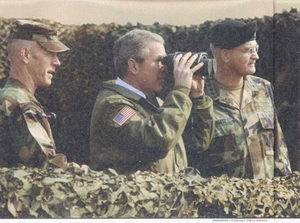
PHOTO: George Bush playing soldier at the DMZ in Korea (note the covers still on the binoculars).

UPDATE - 3/16/08:

When I mentioned these volunteer options for Dubya on Hullabaloo, a commenter pointed out: "My God, haven't they suffered enough?" The point is well taken, but somehow I don't think anyone needs to lose any sleep over his showing up at a clinic for TBI victims. Bush has already declared his retirement goals: clearing brush, riding his mountain bike and making incoherent speeches for big money.