Monday, March 24, 2008

R.I.P. Rovers

The Bush/Cheney administration, in yet another demonstration of its contorted priorities, is cutting off funding for NASA's Mars Rovers. These two 'bots have been successfully exploring our twin planet since January 2004, producing solid science as well as stunning panoramas of the Martian sky and landscape.

It sounds like a done deal, even though the Rovers have proven their worth by exceeding their predicted three-month lifespans by more than four years. They offer real scientific value for the relatively low cost of $20 million per year. Yet Bush would rather send astronauts to Mars at an estimated cost of $230 billion over the next twenty years. Go figure. Bush has also proposed a costly base for astronauts on the moon, to be (conveniently) financed by his successors.

Launching humans into space is prohibitively expensive, especially considering the desperate and obvious needs on earth. But wandering robots on Mars and other planets are a sound and relatively small investment in basic science, and the construction (by robots) of a large array of radio telescopes on the far side of the moon also seems like a solid long-term goal.

Abandoning the Rovers would be yet another unforgivable blunder. After all, Mars is the only other planet that might be capable of supporting life once our species has finally rendered the earth uninhabitable.

Be sure to sit back and spend a few minutes watching Martian clouds drift by while you still have the chance.

[H/T to Tristero at Hullabaloo.]

PHOTO: Exploration Rover Spirit's panorama of the West Valley. It landed near the horizon in the center of this picture. (Courtesy NASA/JPL-Caltech.)

Sunday, March 23, 2008

Blues Break: Shredmeister Jeff Healey - "Roadhouse Blues"


The late Jeff Healey and his band do a cover of The Doors' Roadhouse Blues in Baden-Baden, Germany, back in 1989. The band had just completed the soundtrack for Road House, released the same year. Before his untimely death on March 3rd at the age of 41, few people realized that Healey had been blind from infancy. He first picked up a guitar at the age of three and developed his unusual playing style as a child.

Friday, March 21, 2008

The Bush/Cheney Endgame - Part II

There's a widespread perception that, for the last seven years, the Bush/Cheney administration has been reeling from one crisis to another — improvising rather than pursuing any grand strategy. While it's hard to disagree with this conclusion, there are a couple common threads that bind the administration's domestic and foreign policies to the point of obsession. These are rarely articulated in any coherent way, but they provide common denominators.

The Bush/Cheney legal endgame on torture, including the veto of the congressional prohibition on waterboarding, fits neatly into a larger scheme for the final ten months of the regime. As Bush continues to seem unconcerned about his legacy, it seems clear that he values just two outcomes for his eight years in office:
  1. No additional attacks on the homeland: Bush and Cheney will deem their regime a great success if they can declare that their national-security decisions were necessary to keep the U.S. safe since September 11th. That result, they'll claim, justifies everything they did: the invasions of Afghanistan and Iraq, the use of torture, the illegal detentions and renditions, the degradation of civil liberties at home.

  2. Increased corporate hegemony over the economy and national politics: Bush can accurately claim that he did everything possible to eliminate restraints on corporate profits and freedom of action in the post-industrial economy. For example, his administration has presided over the aggressive dismantling of the federal regulatory apparatus, with predictable effects on the mortgage industry, environment and elsewhere. To the extent that the administration had an economic strategy at all, that was it.
In a political system that struggles to look beyond the two-, four- and six-year terms of its leadership, this sort of short-term (or two-term) thinking has again yielded nothing but disaster. The difficulties are compounded when the lack of strategic vision is combined with Bush's a priori, ideological approach to problems. In the mental world of George Bush, all assumptions are immune from empirical testing and revision.

If no further terrorist attacks occur in the U.S., even on the scale of London or Madrid, it would be quite a leap to agree with the Bush/Cheney claim that their policies deserve all the credit. The harsh context for such a claim shouldn't be overlooked: 3,993 U.S. troops have lost their lives in Iraq, another 29,314 have been wounded and hundreds of thousands of Iraqis have been killed or injured in an illegal war of aggression [1].

Meanwhile, the long-term security of the U.S. has been deeply compromised as world opinion has turned dramatically against the Bush/Cheney regime. Any claims to U.S. moral authority are now laughable, as even our British allies seem to recognize. The next administration will have to act dramatically to repair the damage by distancing itself from Bush/Cheney and their policies (for which there's a modest 12-step program).

The economic cost of Bush's short-term thinking is a deepening recession that has already imposed hardships and may require years of recovery. While expanding federal power through the growing National Security State, Bush/Cheney have been aggressive proponents of the Reagan "revolution's" hostility towards domestic programs, even including disaster relief, and regulation. [2]

The administration is staggering towards the exit, deferring the resolution of these crises and doing everything imaginable to escape blame. The next occupant of the White House will be greeted by piles of steaming turds in every closet, under all the furniture, in every heating duct and in other places that we can't even imagine yet. The stench will be in the air for years, and no disinfectant is powerful enough to remove it.


NOTES

[1] Source: Iraq Coalition Casualties.

[2] On the other hand, they've been very selective in adopting the principles of Reaganism. In his famous "Star Wars" speech in 1983, Reagan declared: "The defense policy of the United States is based on a simple premise: The United States does not start fights. We will never be an aggressor." [Seven months later, he ordered the unprovoked invasion of Grenada.] And: "History teaches that wars begin when governments believe the price of aggression is cheap."

PHOTO: Bush/Cheney join the celebrations at the end of their terms (Wikimedia).

Saturday, March 15, 2008

Some retirement options for Dubya

During a teleconference on Thursday with U.S. personnel stationed in Afghanistan, George Bush reportedly said:
"I must say, I'm a little envious. If I were slightly younger and not employed here, I think it would be a fantastic experience to be on the front lines of helping this young democracy succeed."

"It must be exciting for you ... in some ways romantic, in some ways, you know, confronting danger. You're really making history, and thanks."

Forty years later, the man clearly regrets his decision to remain home when he could've easily arranged a tour or two in Vietnam after he finished college. Apparently he hasn't been able to persuade his two daughters into signing up for gigs in Iraq or Afghanistan, but it's not too late for him to vicariously witness the excitement and romance of combat.

Consider, for example:
The nature and sheer extent of American casualties [in Iraq] — officially in the tens of thousands, but hundreds of thousands have sought medical help — has caught the U.S. government off guard.

From wounded soldiers who faced dilapidated conditions at Walter Reed Army Medical Center to troops whose mental problems have been overlooked, Iraq veterans have paid the price.

"The government was not ready for the casualties to come home," says Brad Trower, 29, a Marine Corps veteran from High Ridge who was injured twice in his tour in Iraq.

When Trower returned to St. Louis in 2005, suffering from traumatic brain injury after two vehicles he was riding in were blown up within a month of his arrival, he got "zero response" initially from local Veterans Affairs officials, though he is now doing well.

Rep. Bob Filner, D-Calif., chairman of the House Armed Services Committee, says the nation has failed to heed the lessons of Vietnam, a war whose veterans constitute half of the 400,000 people sleeping on America's streets tonight.

Though the number of veterans today is smaller, the percentage of veterans who become homeless, commit suicide or face other social problems, partly because of a lack of treatment, is similar to that of the Vietnam era, Filner says.

"We know how to deal with it," he says, "but we apparently don't want to deal with it."

[...]

Of the 1.7 million service members with recent combat experience, some 800,000 are now veterans entitled to VA health care and benefits. Of those, 300,000 have had treatment; 40 percent were diagnosed with a mental health problem, more than half with PTSD, according to Veterans Affairs figures released as a result of a lawsuit by Veterans for Common Sense, a nonpartisan veterans advocacy group. Paul Sullivan, the group's executive director, says the patient figure could eventually reach 700,000.

[...]

Thirty-one percent of the veterans have filed disability claims, waiting on the average more than six months for them to be processed. Delays are pronounced for those who returned to small towns or rural areas in the Midwest or South far from VA facilities, as happens with many reserve troops.
There are an estimated 10,000 veterans who have suffered traumatic brain injuries in Iraq and Afghanistan from roadside bombs and other causes, and many of them will require intensive lifelong medical and personal care. Another 800 veterans of Iraq and Afghanistan lost limbs due to amputations since 2001.

This tragic situation [1] offers many volunteer opportunities for Bush, even if he's not eager to relocate to Iraq or Afghanistan. After all, he won't be "employed here" after next January 20th. So let me offer a few modest suggestions for how he might spend his spare time after clearing brush on the Crawford ranch:
  • He can volunteer for the Walter Reed Army Medical Center's Auxiliary, which offers "the opportunity for fun and friendship, for networking and sharing, as well as a chance to support our hospital and its patients."
  • If he has a little spare change after paying his dues at his golf club in Waco, he can contribute to Walter Reed Hospital's Army Emergency Relief Fund , which provides for veterans' "emergency financial needs such as food, rent, utilities, emergency transportation and vehicle repair, funeral expenses, medical/dental expenses, or personal needs when pay is delayed or stolen." And he doesn't even have to wait until he qualifies for unemployment.
  • Dubya might also join Stephen Colbert in cutting some generous checks for the Fisher House veterans' program, which provides "'a home away from home' that enables family members to be close to a loved one at the most stressful time -- during hospitalization for an illness, disease or injury."
Bush may be denied the "fantastic experience" and "romance" of Iraq and Afghanistan due to his age, but they can vicariously take part in those wars through the accounts of returning veterans by volunteering at Walter Reed, the Waco VA Medical Center or any other VA hospital across the land.

And keep those checks coming, too, George. A recent Harvard study predicts that "taxpayers' cost for the care of injured veterans will run up to $700 billion."

NOTES

[1] The Veterans for Common Sense website is brimming with valuable but underreported information about the plight of veterans. For example, the site cuts through the Pentagon's statistical games: "There are nearly 61,000 non-fatal casualties from Iraq, plus 8,000 non-fatal casualties from Afghanistan. A grand total of 69,000 battlefield casualties from the two wars." Meanwhile, the 3,988 U.S. troops have lost their lives in Iraq, 487 in Afghanistan.

[2] To help him prepare for his new career as a volunteer, Dubya might take a look at Elizabeth Reuben's article on the current situation in Afghanistan in the New York Times Magazine (February 24th).

With a tip o' the hat to Fred Kaplan at Slate and Digby at Hullabaloo. A commenter on Hullabaloo came up with this highly-relevant quote from F. Scott Fitzgerald's The Great Gatsby:
"They were careless people... they smashed up things and creatures and then retreated back into their money or their vast carelessness... and let other people clean up the mess they had made..."
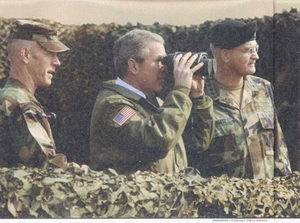
PHOTO: George Bush playing soldier at the DMZ in Korea (note the covers still on the binoculars).

UPDATE - 3/16/08:

When I mentioned these volunteer options for Dubya on Hullabaloo, a commenter pointed out: "My God, haven't they suffered enough?" The point is well taken, but somehow I don't think anyone needs to lose any sleep over his showing up at a clinic for TBI victims. Bush has already declared his retirement goals: clearing brush, riding his mountain bike and making incoherent speeches for big money.

Monday, March 10, 2008

Blues Break Double Header: Robert "Wolfman" Belfour


Robert Belfour jams on a back porch during the Centrum Blues Workshop, Port Townsend, Washington State, in August, 2007. This is an instrumental version of Old Black Mattie. The sound quality is only marginally better than in an earlier Wolfman Blues Break, but it's well worth a listen anyway.

Can't seem to get enough of this guy—he's the real deal. Too bad I missed him when he was here in the Pacific Northwest. Here he is again, with somewhat better acoustics, performing his classic Done Got Old (date and location not available):

Saturday, March 08, 2008

The legal endgame

After he vetoed H.R. 2082, the “Intelligence Authorization Act for Fiscal Year 2008,” George Bush submitted the following explanation to the House of Representatives:
"Section 327 of the bill would harm our national security by requiring any element of the intelligence community to use only the interrogation methods authorized in the Army Field Manual on Interrogations. It is vitally important that the Central Intelligence Agency (C.I.A.) be allowed to maintain a separate and classified interrogation program... While details of the current C.I.A. program are classified, the attorney general has reviewed it and determined that it is lawful under existing domestic and international law, including Common Article 3 of the Geneva Conventions."
Forgive me for taking no comfort in the claim that the Attorney General has "reviewed" and approved the classified program.

Veto or not, "harsh interrogation practices" like waterboarding will be discontinued after next January 20th if a Democrat is elected.

So all this gets curiouser and curiouser, legally speaking. Why all the fuss, if the torturers might only be in business for another ten months?

The federal criminal code (18 USC 2340A) already prohibits acts of torture "committed by a person acting under color of law specifically intended to inflict severe physical or mental pain or suffering... upon another person within his custody or physical control." Additional provisions describe in some detail the forms of "severe physical or mental pain or suffering" that are encompassed by the prohibition:
"(A) the intentional infliction or threatened infliction of severe physical pain or suffering;

"(B) the administration or application, or threatened administration or application, of mind-altering substances or other procedures calculated to disrupt profoundly the senses or the personality;

"(C) the threat of imminent death; or

"(D) the threat that another person will imminently be subjected to death, severe physical pain or suffering, or the administration or application of mind-altering substances or other procedures calculated to disrupt profoundly the senses or personality..."

It would take a prodigious feat of dissembling to convince a sober juror that this statute doesn't prohibit "harsh interrogation techniques" like waterboarding. (Although that's what lawyers often try to do, obviously.)

The existing law further provides for "federal extraterritorial jurisdiction" if the perpetrator is a U.S. national or the alleged offender is "found within the United States, irrespective of the nationality of the victim or the alleged offender."

If convicted, defendants can be sentenced to up to 20 years in prison or, if the victim was killed, the death penalty. Any person who conspires to commit torture is subject to the same term of imprisonment, but not the death penalty. A conspiracy charge could certainly be filed against any official who authorized acts of torture.

Here's the heart of the mystery: why enact a measure like HR 2082 when the legal toolbox is already adequate to prosecute torturers and those who authorize it?

By passing this bill, Congress implies that there's some ambiguity about whether waterboarding constitutes "torture" within the meaning of the existing statute, which was adopted in 2000. [1] It's stupid, unnecessary and plays into the legal strategy for Bush's endgame, which is to preempt prosecutions of administration officials who authorized torture and create ambiguity about what the law permits.

While one can appreciate Congress' interest in using its funding authority to limit torture, a Bush veto was inevitable. There's no hint that Bush/Cheney have any concern about how the U.S. is perceived in the world, or how his position on torture may affect U.S. troops who themselves become prisoners. These are issues for future administrations, and therefore irrelevant.

Meanwhile, Attorney General Michael Mukasey has initiated an internal ethics investigation of attorneys who approved the use of waterboarding—a process that, at best, would result in nothing more than removal from office. [2]

The far better course for Congress is to aggressively pursue the appointment of an independent counsel to prosecute administration officials who authorized torture. An in-depth congressional investigation is also long overdue [3]. Until those things happen, the Democrat "majority" will be dancing to the Bush/Cheney playbook.

NOTES

[1] The media have uncritically bought into the administration's notion that waterboarding falls into some gray area under existing law. Witness today's NYT article on the veto, which downplays waterboarding as "a technique in which restrained prisoners are threatened with drowning" [my emphasis].

[2] Mukasey has declined to prosecute waterboarders and administration officials on the ground that they relied on legal advice from DOJ attorneys. This is a variation on the "only following orders" defense, which wasn't received very well at Nuremberg. The Uniform Code of Military Justice permits U.S. troops to refuse orders that require illegal acts. Subordinates have a duty to disobey laws requiring them to commit criminal offenses under federal statutes. Once again: there is no ambiguity in the federal law, and it's a mistake to imply any.

[3] As the Bush veto again illustrates, the next administration will have to take very drastic measures to disassociate itself from the Bush torture regime (as noted in more detail here, here and here). A few exemplary prosecutions of war criminals would be a good start.

PHOTO: Water torture in Antwerp, 1556 (Wikimedia).

Wednesday, March 05, 2008

Denver's perfect storm

During the tense weeks following the 2000 election, every new development seemed to fall neatly into a pattern that would inexorably place the final determination before the Florida legislature or the U.S. House of Representatives. If the result in Bush v. Gore had been different, that "perfect storm" might've been realized. [1]

And so it seems once again, seven years later, as the cumbersome nominating machinery grinds toward a possible contested Democratic convention in Denver starting on August 25th.

The Democratic primaries have failed to produce an early winner even though the whole electoral system was redesigned to avert a long, internecine conflict that might produce a divided party on Labor Day. With two compelling candidates and an electorate that seems evenly split in many states, the delegate selection process could easily produce a nightmare scenario in Denver that may yet deliver the presidency to John McCain. The irony of that result, after two terms of the worst administration in U.S. history, would be overwhelming.

The doomsday scenario for Democrats seems more plausible today than it did on Monday. Hillary Clinton emerged from Tuesday's four primaries with a net gain of only 12 delegates, leaving her behind in the current count by 111 (according to CBS). Yet she has clearly blunted the impressive momentum that Obama has built up after twelve straight wins during the last month. She has exploited vulnerabilities in Obama's resume and, incredibly, argued that only she and John McCain are qualified to serve as commander-in-chief. [2] Obama remains in a very strong but weakened position.

So imagine the following sequence:
  1. Clinton wins Pennsylvania on April 22, but not solidly enough to capture the lead in delegates.
  2. The candidates split the remaining primaries, but due to proportional voting neither one emerges with anything approaching the 2,024 delegates needed to win the nomination.
  3. The superdelegates who haven't yet committed to either candidate agree to withhold judgment until all the primaries are over.
  4. A nasty fight develops over seating the Michigan and Florida delegates, who would support Clinton and possibly even put her over the top. But neither the party nor the courts are likely to seat delegates elected in primaries that weren't supposed to count. That result would be grossly unfair to Obama and all the other candidates who didn't campaign (or even get on the ballot) in those two states. [Variation on nightmare scenario: a lawsuit captioned Obama v. Clinton that's resolved 4-3 by the U.S. Supreme Court.]
  5. Florida and Michigan vote again in July but neither candidate wins decisively.
  6. Obama goes into the convention with slightly more popular votes in all the primaries combined, but the total difference is less than 1%. [Until yesterday, he led Clinton by about a million votes nationally.]
  7. Obama wins the most states (27 so far), but Clinton has carried the most populous states (including California, New York and Texas) along with several swing states (like Ohio) that Democrats need to carry in November.
  8. Neither candidate—understandably, in such a close competition—is willing to withdraw for the sake of party unity
  9. All the while, both candidates attack each other relentlessly and raise each other's negatives, turning off many voters and demoralizing party activists.
Now imagine that you're one of the 794 superdelegates in Denver (and, technically speaking, none of the superdelegates is legally bound to any candidate). Here are your options if this perfect storm scenario exists:
  • You could choose whom you'll support based on the total popular vote, but our assumption is that it's very evenly split. (It would be equally complicated if Clinton increases her percentage of the popular vote, or even emerges with a majority).
  • You could choose based on the number of states carried by the candidate, which would favor Obama but ignore many of the larger states.
  • You could go with your instincts and vote for the candidate you deem most likely to win in November. Or,
  • The party leaders could negotiate a deal that results in the withdrawal of one candidate with the understanding that he or she would be the vice-presidential candidate (or perhaps majority leader of the Senate or secretary of an important cabinet post).
Any one of these choices will be denounced as "undemocratic" by loyalists to the losing candidate and a large segment of the voting public, and the mainstream media will have a feeding frenzy over the inevitable smoke-filled-room metaphor.

If there's an upside to all this, it pales in comparison with the dangers. But a few points are worth mentioning:
  • McCain and the Republicans won't be able to focus their attack on either candidate (but see item #9 above).
  • Participation in the primaries could remain very high, with unprecedented numbers of people taking part as voters and campaign workers (item #9 again).
  • The candidates will have extended opportunities for free media as public interest in the campaigns remains high.
  • Both candidates will be tested to the limit and forced to refine their messages for the fall campaign.
With the focus off McCain, he gets something like a free ride (with a few exceptions) while the Democrats spend money attacking each other. And McCain may have relatively little money to spend, thanks to his current dispute with the FEC. Though he wouldn't get as much free media as the Democrats, an adoring press is unlikely to ignore him.

As in 2000, a lot of contingencies have to fall into place in order to produce a perfect storm in Denver. But so far events seem to show an uncanny ability to do just that.

NOTES

[1] As I interpreted the situation back then, the constitutional process would've still produced a Bush victory, and it would've been even more protracted and controversial.

[2] The red phone ad may be counterproductive for Democrats. If the question is "who would you rather have answer the phone at 3:00 a.m.?" a lot of voters might respond "John McCain."

Saturday, March 01, 2008

The postpartisan vocabulary

As the allegedly "postpartisan" John McCain scurries to make peace with the hardcore conservatives in his party, it comes as no surprise to hear him indulging his audience's preferences in political nomenclature. A case in point was a speech on Friday in which McCain denounced the two "Democrat candidates" for opposing the North American Free Trade Agreement (NAFTA) [1].

Nowadays there's nothing unusual about McCain's ungrammatical conversion of the familiar noun Democrat into an adjective. Many Republican politicians use it routinely and without hesitation, as do conservative talk-show hosts on television and radio. It's slowly infiltrating the language, exactly as intended.

The origin of this particular usage of Democrat isn't clear to me, but it's the first time I've heard it from McCain's mouth. The problem facing Republicans is made illustrated in a speech that Dubya made in February 2003 to justify the invasion of Iraq: "The world has a clear interest in the spread of democratic values..." So how do you talk about "democratic values" without associating yourself with, or even glorifying, your political opposition? The solution is to drive a linguistic wedge between them by dropping the -ic suffix.

The first references to the "Democrat party" likely came long ago from ideologues like Karl Rove, Newt Gingrich or Tom Delay, or maybe even from an earlier generation [2]. But the current attempt to turn Democrat into an openly pejorative term represents a systematic application of propaganda theory. This campaign has some distinctive features:
  1. It subtly disassociates the "Democrat party" from the "democratic" principles that, by implication, Republicans like Bush feel uniquely qualified to claim as their own. The reference to Democrat refers to individuals rather than concepts, and in so doing it tries to invoke traditional stereotypes about liberals, congress and corrupt machine politicians.
  2. Through endless repetition, Republicans hope that "Democrat party" will infiltrate the political vernacular, eventually replacing "Democratic party" in popular usage. The ultimate goal is for the media to reflexively apply Democrat to the party, its candidates and its platform.
  3. It really, really pisses off Democrats—to the point of apoplexy in some cases. At the same time, the targets are rendered helpless and defensive: they don't want to appear petty by challenging the misuse of the noun Democrat as an adjective. Besides, the same word serves them and their party perfectly well as a noun.
  4. The campaign largely remains off the radar screen for the media, which at most views it as a minor irritant to overly-sensitive Democrats. On the rare occasions when a reporter challenges the usage, the speaker simply laughs and claims that it's just a habit or maybe a slip of the tongue, but in any case no offense was intended.
While this campaign may seem subtle and comparatively innocuous, the constant misuse of Democrat is designed to demonize and belittle the party and its candidates. If they can create a linguistic barrier between the "Democrat party" and "democratic" principles, Republicans can finally appropriate the adjective as part of the quasi-religious construct that Bush/Cheney used to justify the invasion of Iraq.

Progressive bloggers have responded in kind by adopting Repubs or repugs (short for repugnants) as a regular part of their vocabulary.

The manipulation of language for ideological ends is hardly a new phenomenon in politics, but the process has been especially pernicious during the Rovian era—which is far from over. With McCain facing either a woman or an African American nominee, the process of linguistic swiftboating has barely begun.


NOTES

[1] McCain argued that NAFTA, like the escalation in Iraq, was a grand idea, and opposing it would be insulting to "our friends" like the Canadians. Whenever I hear a politician refer to "our friends" in other countries these days, I have to wonder whether there's any basis for that characterization--even when the "friends" in question are Canadians or Aussies. By associating himself so closely to the war in Iraq and NAFTA, McCain may again be hitching his wagon to two of the wrong horses, depending on the fate of the economy and the surge.

[2] A 2006 article in Media Matters notes that Hendrik Herzberg of the New Yorker can trace this usage "as far back as the Harding administration." It was routinely applied by Republican luminaries like Joe McCarthy and, not surprisingly, Bob Dole. The article states: "Hertzberg wrote that 'among those of the Republican persuasion, the use of Democrat Party is now nearly universal' thanks to 'Newt Gingrich, the nominal author of the notorious 1990 memo [and here] Language: A Key Mechanism of Control, and his Contract with America pollster, Frank Luntz.'" The intent, Herzberg writes, is "to deny the enemy the positive connotations of its chosen appellation."

PHOTO: Newt Gingrich (wearing no flag pin!) and Trent Lott in happier times. (Wikimedia)

Friday, February 29, 2008

Blues Break: John Fahey - "Red Pony" (1969)


Here's the description of this performance from YouTube:
John Fahey performs "Red Pony" on Laura Weber's "Guitar Guitar" TV show in 1969. From the DVD "John Fahey in Concert and Interviews 1969 & 1996."
The guitar is in open G tuning (I think).

I saw Fahey (1939-2001) open for his protegé Leo Kottke at Reed College in Portland back in 1970 (or maybe 1971). Fahey walked onto the stage, sat down on a stool, chugged a can of beer and plunged into a dazzling (but too short) 30-minute set without a word. At the end he got up and said, "now it's time for the guy you really came to hear," then walked out. There was no hint of irony in his comment: a very sad, even shocking, moment. I never saw him perform again even though he moved to Salem, just an hour down I-5, ten years later.

There's a rumor in my family that Fahey was a distant relation on our paternal grandmother's side, but I have no confirmation of this claim.

Wednesday, February 27, 2008

Trivializing pursuits

One might be excused for thinking, for a moment, that columnists and pundits would be slightly more sensitive to stereotypes after Chris Matthews was forced to apologize to Hillary Clinton for a long series of misogynist remarks. Not so.

A case in point is a snide and profoundly unfunny column by Joel Klein that appeared in the Los Angeles Times (and locally in the Portland Oregonian). Professing that he will "miss" Hillary Clinton, Klein regurgitates clichéd references to her physical qualities, appearance and gender-based expectations:
  • "her creepy laugh"
  • "the way she tried to bring back the pantsuit"
  • "The woman even managed to get better looking as she aged." [A comment that, somehow, doesn't come across as a compliment.]
  • "You wanted cookies, and she whipped up an oatmeal chocolate chip recipe."
  • "As the mean kids figured out in high school, you can make the smart girl do anything."
  • "Hillary's problem is that she was too good."
  • "...such personalities are far less annoying whiny than self-satisfied."
  • "...that awful burst of cackle stayed with me."
Klein's litany overlooked only a handful of the more familiar adjectives that are applied to Clinton, like shrill and Tucker Carlson's castrating, overbearing and scary.

Unfortunately, the ancient sport of ridiculing women (and specifically Hillary Clinton) for their appearance is not limited to Maureen Dowd or the conservative right, as a minute of surfing will reveal.

Ridicule is a uniquely powerful, and often unanswerable, political tool. Hillary Clinton or any other other politician can, and certainly should be, subjected to a din of satire and ridicule when they deserve it. Everyone invites public derision when they act or speak stupidly—politicians especially, since their bad choices affect so many other people. But it's unfair and offensive to perpetuate stereotypes by ridiculing people for qualities that are beyond their control [1], including gender, race, age and physical appearance.


NOTES

[1] Okay, fashion choices are within our control. But critics who dwell at length on Hillary Clinton's outfits—or Condi Rice's for that matter—would rarely report on the wardrobes of John McCain or (unless he's wearing a turban or no flag pin) Barack Obama.

PHOTO: Clinton and Obama making fashion statements.

Saturday, February 23, 2008

Hillary Clinton in Texas debate


As promised a few weeks ago, here's an eloquent statement by Hillary Clinton at the most recent Democratic debate in Texas. As a lifelong Democrat, I have to say that I'm proud of both these candidates and look forward to voting for one of them. And that one, almost certainly, will be Barack Obama.

Although they've exchanged a few harsh words in debates, Hillary Clinton's many talents will probably not be overlooked if Obama wins in the fall. She deserves a prominent place in the new cabinet, or as the new majority leader in the Senate. Maybe she can overcome her regrettable tendency towards a kind of "bipartisanship" that often requires caving in to the opposition's agenda.

Saturday, February 16, 2008

"Into a different game..."

In an interview with the BBC on February 12th, U.S. Supreme Court Justice Antonin Scalia (left) addressed the question of torture in the following terms:

"To begin with the constitution... is referring to punishment for crime. And, for example, incarcerating someone indefinitely would certainly be cruel and unusual punishment for a crime."

Scalia argued that courts could take stronger measures when a witness refused to answer questions:

"I suppose it's the same thing about so-called torture. Is it really so easy to determine that smacking someone in the face to determine where he has hidden the bomb that is about to blow up Los Angeles is prohibited in the constitution?" he asked.

"It would be absurd to say you couldn't do that. And once you acknowledge that, we're into a different game.

"How close does the threat have to be? And how severe can the infliction of pain be?"

Here, once again, is Scalia's version of "strict constructionism" in action: the "punishment" narrowly refers to sanctions imposed by a court following a criminal conviction.

Scalia seems to believe that the authors of the Bill of Rights weren't really concerned about how people in pretrial custody, for whatever reason, were treated. He implies that the 9th Amendment doesn't restrict coercive interrogations during the investigative process, when the presumption of innocence applies to suspects or defendants in the U.S. legal system. So "smacking someone in the face" is permissible, then, for a suspect (or maybe even a witness) who's presumed to be innocent—but not, Scalia generously allows, for convicted criminals.

There's a separate and quite vast body of law, of course, that applies to coerced confessions by persons who are merely suspects in criminal cases. Seventy-two years ago, in Brown v. Mississippi [1], three black defendants were sentenced to death following their conviction for murder. Despite uncontested evidence of torture, the state Supreme Court affirmed the jury's verdict. Two courageous Mississippi judges dissented and described the events that led to the three "confessions:"
    "The crime with which these defendants, all ignorant negroes, are charged, was discovered about 1 o'clock p.m. on Friday, March 30, 1934. On that night one Dial, a deputy sheriff, accompanied by others, came to the home of Ellington, one of the defendants, and requested him to accompany them to the house of the deceased, and there a number of white men were gathered, who began to accuse the defendant of the crime. Upon his denial they seized him, and with the participation of the deputy they hanged him by a rope to the limb of a tree, and, having let him down, they hung him again, and when he was let down the second time, and he still protested his innocence, he was tied to a tree and whipped, and, still declining to accede to the demands that he confess, he was finally released, and he returned with some difficulty to his home, suffering intense pain and agony. The record of the testimony shows that the signs of the rope on his neck were plainly visible during the so-called trial. A day or two thereafter the said deputy, accompanied by another, returned to the home of the said defendant and arrested him, and departed with the prisoner towards the jail in an adjoining county, but went by a route which led into the state of Alabama; and while on the way, in that state, the deputy stopped and again severely whipped the defendant, declaring that he would continue the whipping... until he confessed, and the defendant then agreed to confess to such a statement as the deputy would dictate, and he did so, after which he was delivered to jail.
    "The other two defendants, Ed Brown and Henry Shields, were also arrested and taken to the same jail. On Sunday night, April 1, 1934, the same deputy, accompanied by a number of white men, one of whom was also an officer, and by the jailer, came to the jail, and the two last named defendants were made to strip and they were laid over chairs and their backs were cut to pieces with a leather strap with buckles on it, and they were likewise made by the said deputy definitely to understand that the whipping would be continued unless and until they confessed, and not only confessed, but confessed in every matter of detail as demanded by those present; and in this manner the defendants confessed he crime, and, as the whippings progressed and were repeated, they changed or adjusted their confession in all particulars of detail so as to conform to the demands of their torturers. When the confessions had been obtained in the exact form and contents as desired by the mob, they left with the parting admonition and warning that, if the defendants changed their story at any time in any respect from that last stated, the perpetrators of the outrage would administer the same or equally effective treatment.
    "Further details of the brutal treatment to which these helpless prisoners were subjected need not be pursued. It is sufficient to say that in pertinent respects the transcript reads more like pages torn from some medieval account than a record made within the confines of a modern civilization which aspires to an enlightened constitutional government."
In unanimously reversing the three convictions, the U.S. Supreme Court rejected the notion of a "trial by ordeal," stating [citations omitted]:
"The rack and torture chamber may not be substituted for the witness stand. The state may not permit an accused to be hurried to conviction under mob domination--where the whole proceeding is but a mask--without supplying corrective process...The state may not deny to the accused the aid of counsel... Nor may a state, through the action of its officers, contrive a conviction through the pretense of a trial which in truth is 'but used as a means of depriving a defendant of liberty through a deliberate deception of court and jury by the presentation of testimony known to be perjured...' And the trial equally is a mere pretense where the state authorities have contrived a conviction resting solely upon confessions obtained by violence. The due process clause requires 'that state action, whether through one agency or another, shall be consistent with the fundamental principles of liberty and justice which lie at the base of all our civil and political institutions...'

"It would be difficult to conceive of methods more revolting to the sense of justice than those taken to procure the confessions of these petitioners, and the use of the confessions thus obtained as the basis for conviction and sentence was a clear denial of due process."
Is waterboarding even "more revolting to the sense of justice" than the treatment of the suspects in Brown? It's certainly not less revolting. Scalia's reference to a "smacking someone in the face" is disingenuous given the catalog of far greater horrors that have been inflicted on suspects in U.S. custody in places like Guantanamo and Abu Ghraib. His comments to the BBC also focus on the extreme situation facing Jack Bauer in 24: the suitcase atomic bomb that's about to go off in Los Angeles [2].

Ah, but Scalia has already argued that the "unlawful combatants" at Gitmo don't have the same legal rights, and freedom from coercion, as the defendants in the Brown case [3]. In another speech in Europe reported by the BBC , he is quoted as follows:
"War is war, and it has never been the case that when you captured a combatant you have to give them a jury trial in your civil courts. Give me a break... If he was captured by my army on a battlefield, that is where he belongs."
Scalia, as usual, is quite reckless about expressing himself, and apparently prejudging, matters that are likely to come before the Supreme Court. To paraphrase the old bumper sticker from the days of the AT&T telecommunications monopoly, Scalia might just say: "I don't care, and I don't have to." Unlike other judges, the Supremes aren't subject to any ethical constraints whatsoever, apart from their own consciences.

While Scalia told the BBC that it would be "absurd" to rule out sticking "something under the fingernail" of a detainee in a difficult situation, at least he seems to think that detainees captured on a battlefield are entitled to the same treat as prisoners of war (although 80% of Gitmo inmates were not captured on the battlefield).

The Bush administration, meanwhile, refuses to grant the Gitmo "unlawful combatants" the same minimal rights available to POW's. The prosecution is seeking the death penalty for six detainees, a sentence that is strictly forbidden for POW's under international law, including the Third Geneva Convention of 1949. These show trials will likely be conducted as the fall election approaches, possibly winning political points for Republican waronterra candidates but deepening worldwide cynicism about the alleged "rule of law" in the U.S.

NOTES

[1] Cite: 297 U.S. 278 (1936). The prosecutor in the case was John Stennis, who was the U.S. Senator from Mississippi from 1947 to 1989.

[2] Any minimally-competent terrorist group would arrange to limit the damage to its plans that might result from the capture of any of its members, especially as the plan is about to be realized. It's likely that the terrorists who had actual possession of such a suitcase bomb would be the only ones in a cell who'd know where it was or where it would be used. Torture would be very unlikely to extract any information of value in that situation.

[3] The three defendants were described as "ignorant Negroes" even in the dissent, and no doubt they were second-class citizens. But at least they were citizens entitled to minimal constitutional protections—once their case went beyond the trial court.

PHOTO: The Washington Note


Friday, February 15, 2008

Blues Break: Big Mama Thornton and Buddy Guy - "Hound Dog"


Willie Mae "Big Mama" Thornton (1926-84) performs this blues classic with a very young Buddy Guy in 1965. She first recorded it in 1952 and made it a big hit nationally in 1953. Four years later, Elvis Presley performed his rock-'n'-roll version* on the Milton Berle Show before forty million people and became a national sensation (and the subject of some controversy). His recording sold four million records in the U.S., making it Elvis' most popular single release.

[*NOTE: This video is from a later Ed Sullivan show.]

Saturday, February 09, 2008

Watching the parade

For a couple weeks now this site has gone into hibernation or, to be more accurate, an attempted sabbatical from politics after months of cerebral overload. The timing, right before super Tuesday, was dismal.

The result on the 5th, for Democrats, seemed to be a draw. But today's three caucuses, swept by Barack Obama, suggest that Hillary Clinton may have only temporarily blunted, rather than stopped, the impressive momentum that he has developed. He now has a small lead in the delegate count (not counting the superdelegates), with primaries in some major states (Texas, Ohio and Pennsylvania) rapidly approaching.

My friends (who have mostly joined the Obama parade) have been taking pains to assure me that their candidate is a deeply closeted progressive who has to pass himself off as a moderate in order to get elected. More likely, given the dearth of convincing evidence either way, he's a blank screen on which people can project their own expectations (or wishful thinking) about his politics. His proposal on health care either reveals a deep conservative and corporate streak, or (as I prefer to think) it's an aberration.

For years, Hillary Clinton has been depicted in some circles as yet another closeted progressive (have you read her Wellesley commencement speech?). Even more than Bill. Like so many others in her party, the argument goes, she's had to conceal her true opinions due to the conservative marinade that this country has been steeped in for nearly 30 years.

With her longer public record, we can predict with greater confidence what Hillary is likely to do in the White House. But that's precisely her problem: we know what to expect, and many voters don't necessarily like it. On top of all that, she's been trashed so relentlessly and for so long by the political opposition and the MSM that she she can now be written off as too "divisive."

The brain reels from an overload of irony. The only truly gratifying result so far is the complete voter rejection of movement conservatives like Fred Thompson and Mitt Romney.

So voters demand "change," possibly even for its own sake. At the risk of grossly oversimplifying, the Continuum of Change now reads something like this:
  • John McCain: the illusion of change, or change for the worse (100 more years in Iraq);
  • Hillary Clinton: incremental change, assuming she has 60 votes in the Senate to end filibusters;
  • Barack Obama: fundamental change of some kind of other, assuming he has the support of his party and 60 votes in the Senate to end filibusters
But the numbers, for now, can't be very reassuring for the Democrats despite two shining candidates who should easily trounce the nominee of a failed party. McCain, not exactly an unknown himself, is highly competitive in the current polling despite his close association with the disasters of the last seven years. The latest national poll for TIME:
Obama 48, McCain 41
Clinton 46, McCain 46
For now, McCain can have it both ways (despite some invective from Limbaugh and Hannity): he's still perceived as a maverick despite years of bellicose rhetoric and his shameless identification with Bush's policies on Iraq and the economy. While Obama has been annointed by the MSM, McCain enjoys a daily miracle of redemption.

The more profound question is whether Clinton or Obama can overcome the deep reservoir of sexism and racism that has percolated through U.S. politics for some four centuries. How many white voters, when faced with that blank ballot, will be unable to bring themselves to vote for a woman or an African American? How will the Republicans craft their campaign to exploit this reluctance? Will the Democrats retaliate by offering innuendo about McCain's age?

Sadly, the arch-reactionary poet e.e. cummings was wrong about most things, including this:
Listen; there's a hell of a good universe next door: let's go.
Too bad that's not an option—at least until November 4th.

NOTES

Full disclosure: This blogger is undecided, and my final decision probably won't mean a damned thing by the time Oregon votes in three month. Lest I sound resentful, extensive reform of the whole ludicrous system of primary elections is long overdue, preferably along the lines recently proposed by the nonpartisan National Association of Secretaries of State.

[A shorter version was cross-posted on Hullabaloo.]


Saturday, January 26, 2008

Obama victory speech in South Carolina


If skillful rhetoric turns out to be major factor in the fall campaign, this man should stroll easily into the White (sic) House.

In fairness, if Hillary Clinton or John Edwards makes a compelling speech, I'll post that too.

Sunday, January 20, 2008

Call us when you're ready

We admit to small faults only to persuade others that we have no great ones.
--Maximes, Francois de la Rochefoucauld (1613-80)
And so it is with Chris Matthews' lame apology for his outrageously sexist comments concerning Hillary Clinton and other women involved in politics. Since I'm not a regular viewer of his program (which I've briefly endured only once or twice), I've left it to others to establish that his toxic emissions were not an isolated incident or two. In a letter to Steve Capus, President of NBC News, for example, activist Gloria Steinem and Kim Gandy, President of the National Organization of Women, described the following:

During an appearance on the January 9 edition of MSNBC's Morning Joe, Matthews said of Senator Hillary Clinton, “the reason she may be a front-runner is her husband messed around” and that “[s]he didn't win there [New York] on her merits.” Matthews has referred to Clinton as a “she devil,” compared her to a “strip-teaser” and called her “witchy.” He has referred to men who support her as “castratos in the eunuch chorus.” He has suggested Clinton is not “a convincing mom” and said “modern women” like Clinton are unacceptable to “Midwest guys.”

Matthews’ sexism is hardly limited to his comments about Clinton; such rhetoric is just the latest in a string of sexist attacks he has made against prominent female political figures.

[...]

In November 2006, shortly after the Democrats took the majority in Congress, Matthews asked a guest if then-presumptive Speaker-elect Nancy Pelosi (D-CA) was “going to castrate Steny Hoyer” if Hoyer (D-MD) were elected House Majority Leader.

During coverage of a presidential debate last spring, NBC News chief foreign affairs correspondent Andrea Mitchell was compelled to remind Matthews that Sen. Barack Obama's (D-IL) wife, Michelle, is a Harvard-educated lawyer after he focused obsessively on her physical appearance.

Repetition of epithets like "she devil" and "witchy" tend to have an overwhelming cumulative effect, creating the perception that the "devisive" Clinton is "unelectable" due to the extreme hostility and high negatives that she generates in certain quarters. There's a self-fulfilling quality to these attacks, and deliberately so. Clinton ends of battling against a presumption that at least some of the hysterical response she generates is grounded in real character and political flaws. She is truly the velcro candidate, which makes it all the more improbable that she's in such a strong position after the first round of primaries.

The tricky question is: if Clinton gets an early lock on the nomination, will the Democrats face the same dilemma as they did in 2004? Namely, a problematic candidate who's acceptable to the mainstream of the party but too deeply flawed to win a national election.

Those who claim that Clinton is doomed as a nominee point to her high negatives, including the alleged 40% of voters who say they would never, ever, categorically and under any circumstances, vote for her. But the practical question is always: what's the alternative? Hillary does well in matchups with all GOP candidates, with McCain presenting the greatest threat to her and Obama:

A Jan. 10 national poll by CNN shows Barack Obama has a 55 percent favorability rating, John McCain 54 percent, Hillary Clinton 53 percent, Rudy Giuliani 46 percent, Mike Huckabee 38 percent and Mitt Romney 31 percent...

Somewhat surprisingly, Clinton and Obama would not only win if the election were held today but would win handily against Giuliani, Huckabee or Romney. This same trend is seen when respondents were asked whom they definitely would not vote for in November. While 38 percent gave thumbs down to Obama and 43 percent to Clinton, 52 percent outright rejected Huckabee, 55 percent Giuliani and 62 percent Romney. The one person who wouldn't be overrun by Obama and Clinton is McCain. McCain's "no" votes [sic] the same as Clinton's, and in hypothetical national matchups, he's in a statistical dead heat with both of them.

Voter perceptions of Hillary Clinton are not engraved in bronze, and a serious of dismissive articles and vicious attacks in the mainstream media have had the paradoxical effect of generating sympathy and raising her public stature. And, maybe, producing a narrow victory in New Hampshire.

The folks at Pollster.com, an excellent resource for current polling, have launched their own online survey that, among many other things, asks: "Do you think that America is ready for a female president?" They also ask whether "America is ready for an African American president."

What, exactly, does it mean to be "ready?" It's quite absurd, really, that such questions have to even be asked. The other day, someone asked me whether voters are willing to cast their ballots for a woman or an African American—making it clear that she was quite prepared to do so, but doubted that the majority of her fellow voters could stomach the thought.

On one level, it's a legitimate question: are U.S. voters capable of overcoming their presumed sexist and racist legacies, or will it be another generation or so before the country is mature enough to elect a woman or minority president? Also, do polls accurately reflect voter opinion on such matters? After all, polls suggested that the 2006 Tennessee senate race—in which African American Harold Ford, Jr., was the Democratic candidate—would be a lot closer than it turned out to be. Polls can't adjust for those who are too embarrassed to admit their racist or sexist motivations.

The fundamental problem for Democrats might be their candidate's gender, or race, and not the specific flaws of Clinton or Obama (both of whom are too reflexively centrist for my taste). The Republican attack machine could, and certainly will, make every effort next fall to transform the favorable ratings that Clinton or Obama currently enjoy. We can expect an absolutely vicious assault based on the kind of racial and sexist slurs and innuendo that have only been hinted at so far in national campaigns. Attacks on Clinton will suffer from the law of diminishing returns, since she is already such a known commodity, but we can only imagine what would be inflicted on Obama.

John Edwards is vulnerable on other grounds, of course, including his long career as a trial lawyer and the media's caricature of his compelling grassroots populism. Unfortunately, he seems to have dropped off the radar screen of viable candidates [1], as determined by ABC, CBS, CNN, NBC, Fox, The New York Times, The Washington Post and all the other usual suspects. Call it another self-fulfilling prophecy.

Are we "ready" for a president who's not a white male? There's every reason to fear the answer to that question.

NOTES

[1] Full disclosure: As an Oregon resident, I won't be able to vote in a primary until May 20th, when the nominations will probably be locked up. More than forty states vote before then. As a registered Democrat, I would be happy to vote in the general election for any of the declared candidates—including Obama, Edwards and Clinton (and not necessarily in that order). If I had to vote in a primary tomorrow, it would be a very tough choice indeed.

Tuesday, January 15, 2008

Quote of the Day: Mike Huckabee

This statement from a Republican candidate whom Fred Thompson denounced as "liberal" (at least on economic issues):
"I have opponents in this race who do not want to change the Constitution," [Mike] Huckabee told a Michigan audience on Monday. "But I believe it's a lot easier to change the Constitution than it would be to change the word of the living god. And that's what we need to do -- to amend the Constitution so it's in God's standards rather than try to change God's standards so it lines up with some contemporary view."
[A tip of the hat David Edwards and Muriel Kane at The Raw Story and Robert Farley at Lawyers, Guns and Money.]

Saturday, January 12, 2008

Blues Break: John Lee Hooker & Carlos Santana - "The Healer"


John Lee Hooker and Carlos Santana perform "The Healer" (date and place unknown).

Thursday, January 10, 2008

Edmond Hillary (1919-2008)

Sir Edmond Hillary, a member of the first party to climb Mt. Everest (also known as Sagarmatha or Chomolungma), died today in New Zealand at the age of 88. He and his Sherpa partner and friend, Tenzing Norgay (1914-86), never revealed who was the first to actually set foot on the summit—an issue that Hillary considered "irrelevant." After summiting in 1953, Hillary went on to climb more Himalayan peaks until he began to show susceptibility to high-altitude pulmonary edema, a condition that can be fatal. He was the first person to stand on the highest mountain on the planet and both the north and south poles .

Hillary devoted much of his life to the work of the Himalayan Trust, which built schools, health centers and hospitals for the impoverished Sherpa of Nepal. The Trust has also initiated major reforestation projects. Hillary was knighted in 1953 and later became an honorary citizen of Nepal, the first foreigner to receive that distinction.

Hillary was an old-school alpinist who had little tolerance for the industrial-scale, summit-obsessed style of Himalayan climbing that is so pervasive today. He was the first to publicly acknowledge the absolutely essential role of the Sherpas, from porters to elite summiteers like Tenzing Norgay, in every phase of Himalayan mountaineering.

PHOTO: Mt. Everest (29,035 ft. /8,850 m.), showing the South Col route followed by Hillary and Norgay on the right skyline (Wikipedia Commons).

Wednesday, January 02, 2008

Nearing the top

With annoying frequency, the U.S. appears at the bottom of various lists of developed nations that are compared on the basis of health care, education and other indicia of their quality of life. But it's not always good news when the U.S. comes in at, or close to, the top.

A case in point is a study of 47 countries, including the world's "leading surveillance societies," by Privacy International.* Based on a thirteen criteria, the U.S. was listed among eight "endemic" surveillance societies that include China, Russia, Malaysia, Singapore, Lithuania and—near the very top—the U.K. The U.S. and Brits are the only western democracies that received the highest rankings.

The 39 surveyed countries with better privacy protections than the U.S. include Canada, Germany, Argentina, Italy, Romania and Estonia all other countries in the EU except the U.K. and Lithuania.

The authors note:
The U.S. was listed among the countries with the "worst records" in 7 out of 13 categories, including:
  • Statutory protection
  • Privacy enforcement
  • Identity cards and biometrics
  • Communications interception
  • Workplace monitoring
  • Surveillance of Medical, Financial and Movement
  • Border and transborder issues
  • Leadership
In its review of U.S. privacy laws and practices, Privacy International noted the following:
  • "No right to privacy in constitution, though search and seizure protections exist in 4th Amendment; case law on government searches has considered new technology
  • "No comprehensive privacy law, many sectoral laws; though tort of privacy
  • "FTC continues to give inadequate attention to privacy issues, though issued self-regulating privacy guidelines on advertising in 2007
  • "State-level data breach legislation has proven to be useful in identifying faults in security
  • "REAL-ID and biometric identification programs continue to spread without adequate oversight, research, and funding structures
  • "Extensive data-sharing programs across federal government and with private sector
  • "Spreading use of CCTV
  • "Congress approved presidential program of spying on foreign communications over U.S. networks, e.g. Gmail, Hotmail, etc.; and now considering immunity for telephone companies, while government claims secrecy, thus barring any legal action
  • "No data retention law as yet, but equally no data protection law
  • "World leading in border surveillance, mandating trans-border data flows
  • "Weak protections of financial and medical privacy; plans spread for 'rings of steel' around cities to monitor movements of individuals
  • "Democratic safeguards tend to be strong but new Congress and political dynamics show that immigration and terrorism continue to leave politicians scared and without principle
  • "Lack of action on data breach legislation on the federal level while REAL-ID is still compelled upon states has shown that states can make informed decisions
  • "Recent news regarding FBI biometric database raises particular concerns as this could lead to the largest database of biometrics around the world that is not protected by strong privacy law."

What is Congress doing to protect its constituents from these predations, which seem to be expanding without restraints? Nothing. In fact, the U.S. has slipped since last year. As noted in the report, "immigration and terrorism continue to leave politicians scared and without principle." And, in an election year, the situation can only get worse. In the absence of any sustained public protests over the loss of personal privacy, the political classes will reflexively favor a growing security regime—even though it's hardly clear that unrestrained government surveillance is actually effective in deterring crime, illegal immigration or terrorism.

NOTES

*This annual survey has been conducted since 1997 by Electronic Privacy Information Center and the UK-based Privacy International. [A tip of the hat to Bean at Lawyers, Guns and Money for the link.]

PHOTO: Wikimedia Commons

Friday, December 21, 2007

Codifying English

"We have room for but one language in this country, and that is the English language, for we intend to see that the crucible turns our people out as Americans, of American nationality, and not as dwellers in a polyglot boarding house."
—Theodore Roosevelt (1906)

Since the first non-English-speaking immigrants arrived in the British colonies of North America, nativist anglophones have fretted about the imminent loss of their language and , by implication, their culture. In its most extreme forms, the English-only movement has supported the complete elimination of Native American languages and, during World War I, the removal of all books in German from public libraries [1] .

Now, capitalizing on the current hysteria over immigration, some thirty states [left] have adopted English as their "official" language. Bills in congress threaten to do the same for the federal government.

Proponents argue that the current wave of immigrants (read: Hispanics), unlike their predecessors from Europe, are unwilling or unable to learn English—a notoriously difficult language to acquire by any standard. Government support of bilingualism, they claim, will only perpetuate the linguistic isolation and economic marginalization of the growing Spanish-speaking minority. The English-only movement raises the dire prospect that unassimilated immigrants will even become a separatist force that will seek reunification with Mexico, undoing the results of the Mexican War and the Gadsden Purchase.

The only response for the nativists is a kind of tough love: Spanish-speaking children will be forced to undergo total immersion in English—all for their own benefit, of course.

As it turns out, the Hispanophobes needn't be so alarmed. A study by the Pew Hispanic Center, released on November 29th, found that:
Nearly all Hispanic adults born in the United States of immigrant parents report they are fluent in English. By contrast, only a small minority of their parents describe themselves as skilled English speakers. This finding of a dramatic increase in English-language ability from one generation of Hispanics to the next emerges from a new analysis of six Pew Hispanic Center surveys conducted this decade among a total of more than 14,000 Latino adults. The surveys show that fewer than one-in-four (23%) Latino immigrants reports being able to speak English very well. However, fully 88% of their U.S.-born adult children report that they speak English very well. Among later generations of Hispanic adults, the figure rises to 94%. Reading ability in English shows a similar trend.
The study also showed:
Latinos believe that English is necessary for success in the United States... Asked whether adult Latinos “need to learn English to succeed in the United States, or can they succeed even if they only speak Spanish,” 89% of Hispanics in the 2002 survey said that they need to learn English. Slightly more Spanish-dominant Hispanics (92%) voiced this belief.

The other side of the coin is that many Latinos believe that inability to speak English well is the leading cause of discrimination against Hispanics. And discrimination is seen as a major problem in keeping Hispanics from succeeding in America: It was cited by 44% of Latinos in the 2002 survey, 58% in the 2006 survey and 54% in the 2007 survey.
Spanish-speaking immigrants have a thorough understanding of the realities that motivated earlier waves of immigrants to acquire proficiency in English as quickly as possible:
How do the patterns we found resemble or differ from those experienced by the last great influx of immigrants a century ago? The broad trajectory appears to be similar. Researchers generally agree that immigrants who arrived a century ago largely spoke their native language, especially at home. Their U.S.-born children used English and their parents’ native tongue. The children of U.S.-born parents—i.e., the grandchildren or later descendants of immigrants—spoke mainly or only English.

[...]

From the first generation to those that follow, we see a nearly complete transition from Spanish to English dominance.
Members of the second and third generations retain the ability to speak some Spanish at home:
Slightly more than half of the second generation (56%) say they speak Spanish very well, as do 29% of the later generations. But Spanish retains a foothold in the third generation and beyond, with 52% reporting they speak it at least pretty well.
But English prevails:
Spanish is the language that most foreign-born Hispanic adults (52%) speak exclusively at home. That proportion drops to 11% among second-generation adults and 6% among those in the third and higher generations.
So if only 6% of third-generation adults speak Spanish at home, where's the great threat that makes it so important to declare English the official language of the U.S.? No doubt the perceived danger has more to do with the skin color, socioeconomic status and demographics of Spanish-speaking immigrants than a desire to maintain the hegemony of the dominant language.


NOTES

The map [inset] shows the states in which English has been designated the "official" language. Three states have two official languages: French and Spanish, respectively, in Louisiana and New Mexico; Hawaiian and English in Hawai'i. [Wikipedia Commons]

[1] When I started public school in Maine, "subprimary" still substituted for the German "kindergarten" ("child's garden") many decades after the end of that war.