Showing posts with label sexism. Show all posts

Sunday, January 20, 2008

Call us when you're ready

We admit to small faults only to persuade others that we have no great ones.
--Maximes, Francois de la Rochefoucauld (1613-80)
And so it is with Chris Matthews' lame apology for his outrageously sexist comments concerning Hillary Clinton and other women involved in politics. Since I'm not a regular viewer of his program (which I've briefly endured only once or twice), I've left it to others to establish that his toxic emissions were not an isolated incident or two. In a letter to Steve Capus, President of NBC News, for example, activist Gloria Steinem and Kim Gandy, President of the National Organization of Women, described the following:

During an appearance on the January 9 edition of MSNBC's Morning Joe, Matthews said of Senator Hillary Clinton, “the reason she may be a front-runner is her husband messed around” and that “[s]he didn't win there [New York] on her merits.” Matthews has referred to Clinton as a “she devil,” compared her to a “strip-teaser” and called her “witchy.” He has referred to men who support her as “castratos in the eunuch chorus.” He has suggested Clinton is not “a convincing mom” and said “modern women” like Clinton are unacceptable to “Midwest guys.”

Matthews’ sexism is hardly limited to his comments about Clinton; such rhetoric is just the latest in a string of sexist attacks he has made against prominent female political figures.

[...]

In November 2006, shortly after the Democrats took the majority in Congress, Matthews asked a guest if then-presumptive Speaker-elect Nancy Pelosi (D-CA) was “going to castrate Steny Hoyer” if Hoyer (D-MD) were elected House Majority Leader.

During coverage of a presidential debate last spring, NBC News chief foreign affairs correspondent Andrea Mitchell was compelled to remind Matthews that Sen. Barack Obama's (D-IL) wife, Michelle, is a Harvard-educated lawyer after he focused obsessively on her physical appearance.

Repetition of epithets like "she devil" and "witchy" tend to have an overwhelming cumulative effect, creating the perception that the "devisive" Clinton is "unelectable" due to the extreme hostility and high negatives that she generates in certain quarters. There's a self-fulfilling quality to these attacks, and deliberately so. Clinton ends of battling against a presumption that at least some of the hysterical response she generates is grounded in real character and political flaws. She is truly the velcro candidate, which makes it all the more improbable that she's in such a strong position after the first round of primaries.

The tricky question is: if Clinton gets an early lock on the nomination, will the Democrats face the same dilemma as they did in 2004? Namely, a problematic candidate who's acceptable to the mainstream of the party but too deeply flawed to win a national election.

Those who claim that Clinton is doomed as a nominee point to her high negatives, including the alleged 40% of voters who say they would never, ever, categorically and under any circumstances, vote for her. But the practical question is always: what's the alternative? Hillary does well in matchups with all GOP candidates, with McCain presenting the greatest threat to her and Obama:

A Jan. 10 national poll by CNN shows Barack Obama has a 55 percent favorability rating, John McCain 54 percent, Hillary Clinton 53 percent, Rudy Giuliani 46 percent, Mike Huckabee 38 percent and Mitt Romney 31 percent...

Somewhat surprisingly, Clinton and Obama would not only win if the election were held today but would win handily against Giuliani, Huckabee or Romney. This same trend is seen when respondents were asked whom they definitely would not vote for in November. While 38 percent gave thumbs down to Obama and 43 percent to Clinton, 52 percent outright rejected Huckabee, 55 percent Giuliani and 62 percent Romney. The one person who wouldn't be overrun by Obama and Clinton is McCain. McCain's "no" votes [sic] the same as Clinton's, and in hypothetical national matchups, he's in a statistical dead heat with both of them.

Voter perceptions of Hillary Clinton are not engraved in bronze, and a serious of dismissive articles and vicious attacks in the mainstream media have had the paradoxical effect of generating sympathy and raising her public stature. And, maybe, producing a narrow victory in New Hampshire.

The folks at Pollster.com, an excellent resource for current polling, have launched their own online survey that, among many other things, asks: "Do you think that America is ready for a female president?" They also ask whether "America is ready for an African American president."

What, exactly, does it mean to be "ready?" It's quite absurd, really, that such questions have to even be asked. The other day, someone asked me whether voters are willing to cast their ballots for a woman or an African American—making it clear that she was quite prepared to do so, but doubted that the majority of her fellow voters could stomach the thought.

On one level, it's a legitimate question: are U.S. voters capable of overcoming their presumed sexist and racist legacies, or will it be another generation or so before the country is mature enough to elect a woman or minority president? Also, do polls accurately reflect voter opinion on such matters? After all, polls suggested that the 2006 Tennessee senate race—in which African American Harold Ford, Jr., was the Democratic candidate—would be a lot closer than it turned out to be. Polls can't adjust for those who are too embarrassed to admit their racist or sexist motivations.

The fundamental problem for Democrats might be their candidate's gender, or race, and not the specific flaws of Clinton or Obama (both of whom are too reflexively centrist for my taste). The Republican attack machine could, and certainly will, make every effort next fall to transform the favorable ratings that Clinton or Obama currently enjoy. We can expect an absolutely vicious assault based on the kind of racial and sexist slurs and innuendo that have only been hinted at so far in national campaigns. Attacks on Clinton will suffer from the law of diminishing returns, since she is already such a known commodity, but we can only imagine what would be inflicted on Obama.

John Edwards is vulnerable on other grounds, of course, including his long career as a trial lawyer and the media's caricature of his compelling grassroots populism. Unfortunately, he seems to have dropped off the radar screen of viable candidates [1], as determined by ABC, CBS, CNN, NBC, Fox, The New York Times, The Washington Post and all the other usual suspects. Call it another self-fulfilling prophecy.

Are we "ready" for a president who's not a white male? There's every reason to fear the answer to that question.

NOTES

[1] Full disclosure: As an Oregon resident, I won't be able to vote in a primary until May 20th, when the nominations will probably be locked up. More than forty states vote before then. As a registered Democrat, I would be happy to vote in the general election for any of the declared candidates—including Obama, Edwards and Clinton (and not necessarily in that order). If I had to vote in a primary tomorrow, it would be a very tough choice indeed.

Saturday, May 05, 2007

Geaghan: A homegrown surge

Barack Obama's strengthening candidacy has incited hordes of white racists to discard their inhibitions—if they have any at all—in what Dave Niewert at Orcinus* calls the "new racism." He describes this phenomenon in the following terms:
Today CBSNews.com informed its staff via email that they should no longer enable comments on stories about presidential candidate Barack Obama. The reason for the new policy, according to the email, is that stories about Obama have been attracting too many racist comments.

So far, we have been regaled with the oft-repeated "Hussein" note, the Fox smear of Obama's Muslim background, followed by Limbaugh's astonishing riff on "Barack the Magic Negro". That these reflect a barely concealed racial animus mixed with general white xenophobia should be obvious, and notably, these are all occurring on a national scale, within ostensibly mainstream media sources.

For right-wing audiences, cues like this signal just how far they can take things themselves. So on the public level, the result of this kind of talk is a regular outpouring of old-fashioned racist bile, permission having been granted by leading right-wing voices.
Niewert continues:
This resurgent racism likes to cloak itself in the pretense of rebellious individualism standing up to the oppression of overbearing "political correctness," or else in academic-sounding terms that fling about misinformation regarding the sciences and sociology to construct a pseudo-rationale for what they euphemistically like to call "race realism."

But pull the cloak aside, and the same old, decrepit racism of a century ago is there, festering like a decaying zombie who refuses to die.

And as the summer goes on, and the presidential campaign picks up steam, and Obama solidifies his already formidable position as a front runner ... well, expect to see a lot more of those zombies crawling the streets of our public discourse.
Or, as I wrote last month in reference to the Imus controversy:
Imus is part of a nauseating (and apparently growing) cultural phenomenon founded on an in-your-face racism, sexism and homophobia that proudly flaunt what they call their "political incorrectness." In reality, "politically incorrect" is nothing more a euphemism for language and symbols that are meant to hurt other people, especially minorities and women. When someone objects, they're accused of being "hypersensitive" and urged to get over it.
And we still have eighteen months until the election. If either Clinton or Obama emerges as a nominee, it's hard to imagine how deep the effluent will get between now and then.

Meanwhile, Harvard has put together an online test (the Implicit Association Test) intended to evaluate whether a person has an automatic preference for one race over another. It's free and takes about 10 minutes. While I have some questions for the assumptions and utility of the test as designed, here are the results for the "European American - African American IAT:"


The most important result: 70% of the respondents had a preference for whites that ranged from "slight" to "strong." 54% had a "moderate" or "strong" preference for whites. About 12% showed a "slight" to "strong" preference for blacks, or about the same percentage as African Americans in the U.S. population. Less than one out of five people had "no preference."

The results could be significant, since 732,881 people took the IAT between 2000 and 2006. But who chooses to take these tests, and why? I suspect that overt racists would be less likely to take it, but the data still reflects a 70% preference for whites.

It's not too surprising that people would have a "preference" for those of their own "race" (whatever that is). Still, it's hard to believe that this is a healthy condition in a very diverse society.


NOTES

*Thanks to Digby at Hullabaloo for the link to Orcinus.

NOTE: There are many other types of IAT's available at Harvard's site.


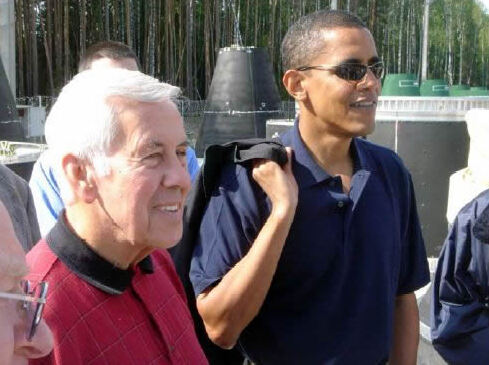
PHOTO: Sens. Barack Obama and Richard Lugar (R-Indiana) tour a Russian base where mobile missiles were being destroyed as part of the Nunn-Lugar program.

Sunday, April 15, 2007

Geaghan: Sunday Snippets from the paper of record

Since she began writing a regular column for the New York Times in 1995, Maureen Dowd's career has been distinguished by an almost indiscriminate series of personal hit pieces on everyone from the Clintons to Al Gore to the Bush dynasty and, this week, Paul Wolfowitz. Her name has even become a verb in some quarters, as in "to dowdify." If she has ever written a kind word about anyone in politics, I must have missed it. (I readily admit, however, that there may be few reasons to write anything positive about our political classes.)

Wolfowitz, the neocon who played a central role in selling and quickly botching the Iraq war, is now embroiled in a scandal involving nepotism, among other things, in his new gig as president of the World Bank. As with Iraq, he seems incapable of recognizing his mistakes. Dowd, as she often does, skewers her target nicely:
Like W., Wolfie is dangerous precisely because he’s so persuaded of his own virtue.
Not surprisingly, people who are so convinced of their own infallibility can do no wrong and are not bound by the same limitations (including the law) that constrain the rest of us. Or so they believe.

Meanwhile, Frank Rich's columns can be equally (and appropriately) devastating for his subjects, except he frequently transcends personal vilification and shifts his focus to the culture at large. In today's column, for example, he explores the fallout from last week's firing of Don Imus by CBS:

The biggest cliché of the debate so far is the constant reiteration that this will be a moment for a national “conversation” about race and sex and culture. Do people really want to have this conversation, or just talk about having it? If they really want to, it means we have to ask ourselves why this debacle has given permission to talking heads on television to repeat Imus’s offensive words so insistently that cable news could hardly take time out to note the shocking bombing in the Baghdad Green Zone...

If we really want to have this conversation, it also means we have to have a nonposturing talk about hip-hop lyrics, “Borat,” “South Park” and maybe Larry David, too.
Though we've been hearing rumors about a national "conversation" on racism for decades, it's not happening now and won't even begin unless our political, cultural or religious leaders are willing to confront some very difficult questions about both our history and current social realities.

Instead, we're seeing a sustained reaction against "political correctness" and "victimology" that's analogous to, and part of, the opposition to feminism documented by Susan Faludi in 1991 in Backlash: The Undeclared War Against American Women (1).

That reaction is based on a simple premise: women, blacks and other minorities may have had some legitimate complaints about systematic discrimination in the past, but American society has evolved towards greater equality. So their litany of complaints is entirely out of proportion to current realities and, thanks to programs like affirmative action, serves only to victimize the white majority (and especially white males). As long as that all-too-convenient perception exists, any "conversation" will be impossible or, at best, unproductive.

The right has added its own variation on this theme: the inequality of African Americans is the result of years of paternalistic federal programs created by Democratic administrations and congresses. These programs have created an unhealthy dependency that has prevented blacks from taking initiatives that might allow them to enter and thrive in the free-market system. As the inflammatory Dinesh D'Souza once wrote, "the American obsession with race is fueled by a civil rights establishment that has a vested interest in perpetuating black dependency" (4).

The reasons for the backlash? Faludi's comments in a 1999 interview still seem valid today:
Look, it's hardly a time of great jubilation for anyone. But it's much harder for men in many respects because they have this feeling that women are rising just as men are falling. The truth is, of course, that women are moving from the subbasement to the basement. By any objective measure -- pay, representation in boardrooms, status -- men are still ahead. But psychologically it's much harder to fall than to climb, even if you land at a higher point than those who are just beginning to rise.
By most measures, of course, African Americans haven't experienced even the limited social and economic mobility that Faludi describes for women (2). Until we have our national "conversation," that reality seems unlikely to change.


NOTES

(1) Followed by Faludi's Stiffed: The Betrayal of the American Man in 1999.

(2) The scope of the problem, contrary to popular perceptions about minority preferences in hiring, was revealed by a 2003 study conducted by researchers from MIT and the University of Chicago. They submitted a large number of job applications that were substantially the same in terms of education and prior experience, but they differed in one respect: half the "applicants" had names that "sounded" African American. Those applicants were 50% less likely to be invited in for interviews, and the percentage was even lower for better paying, more responsible positions. [See also this article by Tim Wise and our posting on the U.S. "Punishment Culture."]

(3) In a January posting, we attempted to apply the academic construct known, awkwardly, as "cultural pseudosubspeciation" to Iraq. That concept has equal application to racial, ethnic and gender relations in the U.S. and elsewhere. Our friend Ellis at Disambiguation (which has been far too quiet of late) has privately expressed some disagreement with our use of that notion. Maybe we can elicit a comment from him, or our hordes of readers, on this subject.

(4) In his lengthy analysis of race relations in The End of Racism (1996), D'Souza also wrote: "Activists recommend federal jobs programs and recruitment into the private sector. Yet it seems unrealistic, bordering on the surreal, to imagine underclass blacks with their gold chains, limping walk, obscene language, and arsenal of weapons doing nine-to-five jobs at Procter and Gamble or the State Department."

PHOTO: The gleaming new headquarters of the New York Times, designed by Renzo Piano, on 8th Avenue in Manhattan.

Saturday, March 10, 2007

IWD + 3

"One is not born, but rather becomes, a woman."
—Simone de Beauvoir, The Second Sex (Volume II)
Thursday, March 8th, was International Women's Day and Blog Against Sexism Day. Since I was out of town for part of the week, I'm getting to this topic three days late. But I certainly don't want to overlook it.

The various forms of sexism have already been described, with his usual flair and insight, by our friend Ellis at Disambiguation. My focus will be on the ultimate goals of the women's movement, which from my perspective go far beyond such familiar issues as legal and economic equality and freedom from discrimination in employment, although those and similar goals remain vital and, far too often, unfulfilled.

International Women's Day (IWD) has been celebrated since 1909. Its organizers were deeply involved in the labor movement, and the women's suffrage movement would soon move back to the center of the national political debate (leading to final ratification of the 19th amendment in 1920). It's revealing that only two countries, Canada and Australia, formally recognize IWD (perhaps due to its early association with socialist women's movements).

More than two centuries after Mary Wollstonecraft published A Vindication of the Rights of Women (1792), and more than forty years after "second wave" feminism emerged, many of the significant goals of feminism remain elusive. Major pieces of legislation have failed to gain enough political support in the U.S., including:
  • The Convention on the Elimination of All Forms of Discrimination against Women (CEDAW): To date, 185 countries have adopted this international treaty. The U.S. remains the only country in the industrialized world that has not adopted the Convention, which is the first "to comprehensively address fundamental rights for women in politics, health care, education, economics, employment, law, property, and marriage and family relations." The Convention has been considered several times by the U.S. Senate since 1980, and was approved by a 12-7 vote in the Foreign Relations Committee as recently as 2002. But the full Senate has never voted on it. Action is long overdue (1).

  • The Equal Rights Amendment (ERA), which simply provides: "Equality of rights under the law shall not be denied or abridged by the United States or by any state on account of sex." The ERA has a very long and complicated history that reveals much about the extent of sexism and recent conservative dominance in U.S. politics. By 1979, the ERA has fallen just three states short of ratification by the necessary 38 states. The current strategy is to seek passage in three additional states, though it's unclear whether such action would come too late to salvage the ERA.
As essential as these (and related) political and economic goals are, the women's movement will finally succeed when gender no longer makes any cultural difference. This goal includes not just legal and economic equality, but a deeper recognition that women are (in the words of Ellis) "fully autonomous agents." No a priori (2) expectations should be imposed on women unless they are based on actual physical differences, notably the biological fact that only women (barring major medical breakthroughs) can get pregnant and bear children. But the real implications of those physical differences are minimal, and the role of men in raising children also deserves legal recognition (in the form of paid parental leave).

One of the most common a priori expectations about women is that they are physically less able than men and must be protected from certain dangers. Conservatives opposed to the ERA argued, for example, that its passage would require women to register for the draft and be assigned to combat duties. With 76 American women killed in combat in Iraq and hundreds more wounded, this argument is even less persuasive than it was thirty years ago. One of every seven U.S. soldiers in Iraq is female and many of them have seen combat. Women can function very effectively in combat roles, as they have demonstrated for decades in the Israeli Defense Force and the Russian army during World War II.

Despite the widespread cultural assumption that women are weak, women are subjected to violence by men on an enormous scale across the planet. For example, consider the following:
  • "Globally, women between the age of fifteen and forty-four are more likely to be maimed or die as a result of male violence than through cancer, malaria, traffic accidents or war combined."

  • "At least one out of every three women has been beaten, coerced into sex or otherwise abused in her lifetime. Usually, the abuser is a member of her own family or someone known to her. Domestic violence is the largest form of abuse of women worldwide, irrespective of region, culture, ethnicity, education, class and religion."
If women are weak, why must they be beaten or intimidated so often into submission?

One of the conservatives' favorite, and most frivolous, arguments against the ERA was that it would require unisex bathrooms that would violate the privacy of both men and women. However, case law has long recognized and allowed for certain gender distinctions, and a right to privacy, based on actual physical differences.

What about affirmative action
would it have to be abolished in a regime of strict equality? No, not until that regime becomes more of a reality. Affirmative action is a form of reparations for centuries of oppression of women, African Americans, Native Americans and others. Affirmative action is a transitional strategy to bring us to a more egalitarian society as quickly as possible.

But what happens to sexuality if, as suggested above,
"gender no longer makes any cultural difference"? The forms of sexuality that are so pervasive in our popular culture are degrading to both genders, but especially to women. Women are encouraged to exploit their status as sexual objects to find a mate, manipulate men, promote their careers and achieve other social goals. On television and in the movies, in magazine ads and thousands of other images, the message is that women are powerful in large part because they can confer or withhold sexual favors. In my work, I often meet teenagers who feel compelled to shoplift clothing (often including items like thong underpants), jewelry and cosmetics in pursuit of the "look" that would allow them to successfully compete in the sexual marketplace.

Despite the gains women have achieved in advancing their legal and economic standing, this cultural perception of female sexuality degrades and limits their options. Women's roles are still defined, in part, by their sexuality and their ability to conform to male definitions of conduct and sexual desirability.

Third-wave feminism, exemplified by the "girl power" movement, attacks some of these cultural stereotypes head on, often with heroic and intelligent cultural icons like Buffy the Vampire Slayer and The Bride (played by Uma Thurman) in the Kill Bill films of Quentin Tarrentino (3). Both characters, however, operate on mythic levels, and the actors who play them certainly conform to popular standards of youthful female beauty. Still, third-wave feminists recognize that the goals of the women's movement can be expressed in a language that is neither legalistic nor academic, and that its potential beneficiaries aren't limited to white, middle-class women. Third-wave feminism often confronts cultural stereotypes about the autonomy of women and their relationships to each other.

As the character Gale Weathers says in Scream 3, "popular culture is the politics of the 21st century." The radical feminism of the sixties and seventies led the way in deeply examining the role of popular culture in perpetuating women's oppression, including the role of language (4) and visual imagery, but mainstream feminism's focus was on ending legal (de jure) and de facto discrimination. Those objectives have still not been reached, but only a thorough confrontation with popular culture will allow feminists to achieve the deepest goals of the movement.

None of this is meant to suggest that sexuality should be banished from popular culture, or that the exploration of sexual themes automatically degrades women. If both men and women can be liberated from rigid stereotypes, a more enlightened sexuality
freed of exploitation and objectificationmight blossom. It hardly needs to be said that sexuality is a vital human activity that deserves the serious attention of artists, writers, poets, sociologists, psychologists and everyone else.

To take all this a step farther, our long-term goals as a political culture should include banishing
all distinctions based on physical characteristics over which we have no control, including:
  • Gender
  • Race (whatever that is), ethnicity, national origin or any related physical features
  • Age
  • Sexual orientation: Though it's unclear whether homosexuality is the result of genetic or environmental factors, the rights of gay men and women shouldn't depend on the final resolution of that scientific question. As Gore Vidal once said, "homosexuality" should only be used in its adverbial form to describe a kind of activity, not a state of being.
  • Physical limitations: Blind people, for example, may need to be treated differently, but to their advantage (as in special classes and guide dogs).
People need not be defined by the physical attributes that they possessed at birth. Those attributes don't have to be totally ignored, of course, but our essentialist culture tends to emphasize them and define people by them (5). In so doing, everyone loses.


NOTES

(1)
Once again the U.S. distinguishes (and isolates) itself by dragging its feet on an important international treaty. It's a long tradition, involving administrations from both parties, that has recently shunned the Kyoto Protocols and treaties on land mines and the International Criminal Court. This revolutionary nation, founded on principles of human rights, has become the principal bastion of the global status quo.

Article I of CEDAW provides that:
"[A]ny distinction, exclusion or restriction made on the basis of sex which has the effect or purpose of impairing or nullifying the recognition, enjoyment or exercise by women, irrespective of their marital status, on a basis of equality of men and women, of human rights and fundamental freedoms in the political, economic, social, cultural, civil or any other field."
(2) Here's a quick definition of the term: "A proposition is knowable a priori if it is knowable independently of experience." In other words, it's a rigid assumption or expectation.

(3) See, for example, the fine essay Scream, Popular Culture and Feminism's Third Wave: I'm Not My Mother, by Kathleen Rowe Karlyn. She notes that women, in the conservative era from which we may be emerging now, are often apologetic about having feminist views: "I'm not a feminist, but..." She writes:
"This resistance to thinking collectively... has serious political consequences at a time when collective action remains necessary not only to advance feminist goals in an age of globalization but to protect its still-vulnerable achievements in the areas of abortion rights, affirmative action, education and healthcare."
(4) It's distressing to see how often even self-identified feminists, not to mention nonfeminist men, still refer to women as "girls." And "chicks" has still not been relegated to the barnyard where it belongs.

(5) Or, to put it another way, sex is "socially constructed:" the culture has added meanings to gender that far transcend mere physical differences.

GRAPHICS: Taking Place and the United Nations