Showing posts with label casualties. Show all posts

Sunday, May 27, 2007

Pushing the envelope

Veterans for Peace established this memorial on the beach at Arlington West in Santa Monica in 2004, and it has expanded relentlessly each year with the casualty count in Iraq.

As of today, the war in Iraq has inflicted 3,454 deaths and 26,188 wounded on U.S. forces. 980 of those deaths have occurred since last Memorial Day weekend, compared to 807 during the previous year. Over two hundred troops have been killed over the last two months alone. It's not unusual for the same number of Iraqis to be killed and wounded over a single weekend.

And it will only get worse, as Bush warned on Thursday:
"We're going to expect heavy fighting in the weeks and months," he said. "We can expect more American and Iraqi casualties." He added, "It could be a bloody -- it could be a very difficult August."
Meanwhile, yet another poll shows that:
"Six in 10 Americans say the U.S. should have stayed out of Iraq and more than three in four say things are going badly there -- including nearly half who say things are going very badly, the poll found."
Last week the Democrats in Congress blinked in their confrontation with Bush over timetables for withdrawal. They had little choice, of course, since they lack the Republican support needed to override the inevitable second veto. The war is funded through September, and it seems unlikely that even these poll numbers will persuade Republicans to desert Bush in sufficient numbers to have an impact on policy. Unless the situation deteriorates dramatically, they're unlikely to go into total panic mode until the primary season begins in 2008.

As a lame duck, Bush is unlikely to be able to pursue any kind of domestic agenda in Congress, for which we can all be grateful. But on Iraq, as with the Gonzales affair, he can safely adopt an in-your-face posture, defying the growing opposition to do something to force a change.

During the 1996 campaign, Bob Dole got exercised because Al Gore visited a Buddhist temple and was rewarded with some $122,000 in (legal) campaign contributions. He asked: "Where's the outrage? When--when will the voters start to focus? ...How far can you push the envelope? How much can you get away with? What can you do? "

The context has changed completely, but eleven years later Dole's questions—which seemed trivial even back then—are far more momentous. Voters are clearly focused on the war, and there seems to be no lack of outrage, but Bush has plenty of reason to believe that he can get away with just about anything—and nothing can be done about it. Sadly, he apparently faces no political consequences even if another 2,000 Americans die in Iraq before January 20, 2009.

PHOTOS: Arlington West [Thanks to Digby at Hullabaloo for the tip.]

Sunday, May 13, 2007

Playing out the clock

In case you haven't heard, the surge in Iraq is a success. For confirmation, all you need to do is tune in to the recent evaluations by George W. Bush, Tony Snow and Fox News. Or listen to John McCain, who (on NBC's Meet the Press) once again regurgitated the Bush line that the U.S. still has "a chance of success" in Iraq.

Lt. Gen. Raymond T. Odierno, commander of U.S. operations in Iraq, declared:
"What I am trying to do is to get until April [!] so we can decide whether to keep it going or not. Are we making progress? If we're not making any progress, we need to change our strategy. If we're making progress, then we need to make a decision on whether we continue to surge."
In fact, it's impossible for the surge to fail, as Robert Farley at Lawyers, Guns and Money (among others, including us) noted a month ago. If U.S. and Iraqi casualties go down, it shows that the pacification plan is working. If casualties go up, then the insurgents are getting desperate, like cornered rats.

In the alternate universe where most of us prefer to analyze our news, the tangible evidence suggests abject failure so far and little patience among the U.S. public for an indefinite continuation of the war. As noted in today's online London Guardian:
The US military surge in Iraq, designed to turn around the course of the war, appears to be failing as senior US officers admit they need yet more troops and new figures show a sharp increase in the victims of death squads in Baghdad.

In the first 11 days of this month, there have already been 234 bodies - men murdered by death squads - dumped around the capital, a dramatic rise from the 137 found in the same period of April. Improving security in Baghdad and reducing death-squad activity was described as one of the key aims of the US surge of 25,000 additional troops, the final units of whom are due to arrive next month.

U.S. combat deaths in Diyala province north of Baghdad have increased by 300% compared to last year, as insurgents have shifted their focus to that region. The commander of U.S. forces in that region complained that he didn't have enough troops to meet the new challenges—still a recurring theme in Iraq, four years into the war.

Meanwhile, 100,000 to 300,000 barrels a day of Iraq's limited oil production has been "siphoned off" through corruption over the last four years. Apparently the proceeds have been used, in part, to fund the insurgency. With an average price of $50 a barrel, and an average diversion of 200,000 barrels a day, that would equal $10 million every day for 1,460 days. Pretty soon we're talking real money (on the order of about $15 billion by my math). That could buy a lot of RPG's and anti-armor munitions, and pay a lot of people to plant IED's along Iraqi roads.

So far in 2007, U.S. military fatalities in Iraq are 50% higher than during the same period (January to mid-May) last year. Looking at April 2007, there have only been three months with more U.S. fatalities since the war began. On average, there were 3.9 U.S. fatalities per day in April, the highest rate since the first few months of the war.

The number of U.S wounded increased by 44% compared to the same period in 2006. Most of the increase in U.S. casualties occurred after the surge began.

Reports of Iraqi casualties are notoriously unreliable, as the recent dispute between the al-Maliki government and the U.N. revealed once again:
In its previous report, in January, the United Nations said 34,452 civilians had died in violence last year, based on information from government ministries, hospitals and medical officials. The Iraqi government put the toll at 12,357. The numbers obtained by the Los Angeles Times indicated civilian deaths numbered 1,991 in January, dropped to 1,646 in February, when the security plan began, and rose to 1,872 in March. [These numbers are very close to those on the Iraq Coalition Casualty Count's website (1)]
Dubya, Cheney and General Odierno may be convinced the U.S. public is prepared to wait until next April for even a preliminary assessment of the surge. But every recent poll reveals that such thinking is delusional, at best.

But the political challenge is clear enough: how to force a change in policy, including a prompt withdrawal from Iraq, before the 2008 election—or, more realistically, before the swearing in of the new president. The Democrats lack the votes to override a veto, much less impeach Bush and Cheney. Congressional Republicans, though they're clearly very nervous about their prospects for 2008, are unlikely to join them in sufficient numbers to force Bush to confront realities in Iraq.

Most likely Bush will grudgingly accept short-term funding of the war and continue to play out the clock until his successor has to contend with his disastrous legacy. Conventional politics inside the beltway don't seem to offer an earlier resolution. Perhaps events, including the effects of intensified political turmoil within the U.S., will intervene in ways that can't now be foreseen.


NOTES

(1) According to the ICCC, Iraqi civilian and military deaths increased by 130% during the "surge months" of March and April 2007 compared to the same two months in 2006. The ICCC site notes: "Iraqi deaths based on news reports. This is not a definitive count. Actual totals for Iraqi deaths are higher than the numbers recorded on this site."

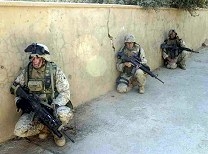
PHOTO: U.S. Marines in Fallujah, Iraq.

Sunday, April 08, 2007

A winner no matter what

The conventional wisdom (here and here, for example) is that the "surge" strategy in Iraq is, so far, a success—as demonstrated just last weekend by Sen. John McCain's tour of the Shorja market in Baghdad, guarded by a hundred heavily-armed U.S. soldiers and five helicopters (1). Overlooked in most of the reporting on this April's Fool tour was the death of six Americans in the Baghdad area that same day and the murder of 21 Shorja market workers and merchants the following day.

But, of course, the surge can't lose, no matter what happens, for all the reasons expressed by Robert Farley at Lawyers, Guns and Money (April 8th):
Remember now; if the Mahdi Army lies low, then the Surge is working. If the Mahdi Army fights back, then the Surge is working. If the Mahdi Army has already dissolved, the Surge is working. If Sadr cooperates, the Surge is working. If he runs, the Surge is working. If he orders attacks, the Surge is working.

It's magical, this Surge; no matter what happens, the evidence demonstrates that the Surge is working. It can't fail! Any behavior taken by anyone in Iraq is a positive by-product of the Surge. I mean, sure, the Surge hasn't dented American casualty rates or Iraqi casualty rates for the country as a whole, but that also is evidence that it's working; the enemy is clearly desperate, which is why he's attacking us.
In fact, U.S. and "coalition" casualties have risen since the surge began, according to the detailed information compiled by the Iraq Coalition Casualties (ICC) site. In the first week of April, for example, 35 Americans and 6 Brits have been killed in Iraq, an average of 5.12 per day compared to 2.65 per day in March and 3 per day in February. If the fatality rate for the first 14 weeks of the year continues, 2007 would be by far the deadliest year for the U.S. since the war began (2):

YearUS Deaths
2003486
2004849
2005846
2006822
2007279
Total3282
Extrapolating from these numbers, over 1,000 U.S. fatalities could be expected this year. Since the surge relies heavily on aggressive short-term urban combat by Americans embedded in neighborhoods with Iraqi police, the casualty rate could easily go higher as the number of troops in Baghdad increases.

Which, for the Bushies, would only prove that the surge is working.

NOTES

(1) Frank Rich's account of this media event for the New York Times (April 7th) skewers both McCain and the surge very nicely, but you can only read it if you subscribe.

(2) From the ICC site, last updated on April 8, 2007. Since then, as reported on tonight's news, six more U.S. soldiers have been killed in Iraq.

PHOTO: The Shorja market in Baghdad on a day last August when Sen. John McCain and his protective task force were elsewhere.