Showing posts with label corruption. Show all posts

Sunday, May 13, 2007

Playing out the clock

In case you haven't heard, the surge in Iraq is a success. For confirmation, all you need to do is tune in to the recent evaluations by George W. Bush, Tony Snow and Fox News. Or listen to John McCain, who (on NBC's Meet the Press) once again regurgitated the Bush line that the U.S. still has "a chance of success" in Iraq.

Lt. Gen. Raymond T. Odierno, commander of U.S. operations in Iraq, declared:
"What I am trying to do is to get until April [!] so we can decide whether to keep it going or not. Are we making progress? If we're not making any progress, we need to change our strategy. If we're making progress, then we need to make a decision on whether we continue to surge."
In fact, it's impossible for the surge to fail, as Robert Farley at Lawyers, Guns and Money (among others, including us) noted a month ago. If U.S. and Iraqi casualties go down, it shows that the pacification plan is working. If casualties go up, then the insurgents are getting desperate, like cornered rats.

In the alternate universe where most of us prefer to analyze our news, the tangible evidence suggests abject failure so far and little patience among the U.S. public for an indefinite continuation of the war. As noted in today's online London Guardian:
The US military surge in Iraq, designed to turn around the course of the war, appears to be failing as senior US officers admit they need yet more troops and new figures show a sharp increase in the victims of death squads in Baghdad.

In the first 11 days of this month, there have already been 234 bodies - men murdered by death squads - dumped around the capital, a dramatic rise from the 137 found in the same period of April. Improving security in Baghdad and reducing death-squad activity was described as one of the key aims of the US surge of 25,000 additional troops, the final units of whom are due to arrive next month.

U.S. combat deaths in Diyala province north of Baghdad have increased by 300% compared to last year, as insurgents have shifted their focus to that region. The commander of U.S. forces in that region complained that he didn't have enough troops to meet the new challenges—still a recurring theme in Iraq, four years into the war.

Meanwhile, 100,000 to 300,000 barrels a day of Iraq's limited oil production has been "siphoned off" through corruption over the last four years. Apparently the proceeds have been used, in part, to fund the insurgency. With an average price of $50 a barrel, and an average diversion of 200,000 barrels a day, that would equal $10 million every day for 1,460 days. Pretty soon we're talking real money (on the order of about $15 billion by my math). That could buy a lot of RPG's and anti-armor munitions, and pay a lot of people to plant IED's along Iraqi roads.

So far in 2007, U.S. military fatalities in Iraq are 50% higher than during the same period (January to mid-May) last year. Looking at April 2007, there have only been three months with more U.S. fatalities since the war began. On average, there were 3.9 U.S. fatalities per day in April, the highest rate since the first few months of the war.

The number of U.S wounded increased by 44% compared to the same period in 2006. Most of the increase in U.S. casualties occurred after the surge began.

Reports of Iraqi casualties are notoriously unreliable, as the recent dispute between the al-Maliki government and the U.N. revealed once again:
In its previous report, in January, the United Nations said 34,452 civilians had died in violence last year, based on information from government ministries, hospitals and medical officials. The Iraqi government put the toll at 12,357. The numbers obtained by the Los Angeles Times indicated civilian deaths numbered 1,991 in January, dropped to 1,646 in February, when the security plan began, and rose to 1,872 in March. [These numbers are very close to those on the Iraq Coalition Casualty Count's website (1)]
Dubya, Cheney and General Odierno may be convinced the U.S. public is prepared to wait until next April for even a preliminary assessment of the surge. But every recent poll reveals that such thinking is delusional, at best.

But the political challenge is clear enough: how to force a change in policy, including a prompt withdrawal from Iraq, before the 2008 election—or, more realistically, before the swearing in of the new president. The Democrats lack the votes to override a veto, much less impeach Bush and Cheney. Congressional Republicans, though they're clearly very nervous about their prospects for 2008, are unlikely to join them in sufficient numbers to force Bush to confront realities in Iraq.

Most likely Bush will grudgingly accept short-term funding of the war and continue to play out the clock until his successor has to contend with his disastrous legacy. Conventional politics inside the beltway don't seem to offer an earlier resolution. Perhaps events, including the effects of intensified political turmoil within the U.S., will intervene in ways that can't now be foreseen.


NOTES

(1) According to the ICCC, Iraqi civilian and military deaths increased by 130% during the "surge months" of March and April 2007 compared to the same two months in 2006. The ICCC site notes: "Iraqi deaths based on news reports. This is not a definitive count. Actual totals for Iraqi deaths are higher than the numbers recorded on this site."

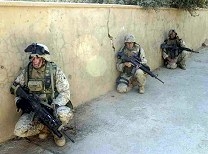
PHOTO: U.S. Marines in Fallujah, Iraq.

Wednesday, February 07, 2007

And so it begins

As the Democratic Congress begins a long-overdue investigation into the management of the Iraq war, stunning details have already emerged that provide a deeper appreciation of the breathtaking incompetence of the Bush administration.

During 2003 and 2004, the U.S. Coalition Provisional Authority, under the command of proconsul Paul Bremer, delivered tons of U.S. dollars to Baghdad as if they were cinder blocks or some other kind of construction material.

The U.S. media has done a creditable job of reporting on the tsunami of dollars, but many of the newspaper articles have been buried in the bowels of the front section. So I turn to the British press for one of the more thorough accounts. Under the headline "How the U.S. sent $12bn to Iraq. And watched it vanish," the London Guardian's David Pallister reports (February 8th):
The US flew nearly $12bn in shrink-wrapped $100 bills into Iraq, then distributed the cash with no proper control over who was receiving it and how it was being spent.

The staggering scale of the biggest transfer of cash in the history of the Federal Reserve has been graphically laid bare by a US congressional committee.

In the year after the invasion of Iraq in 2003 nearly 281 million notes, weighing 363 tonnes, were sent from New York to Baghdad for disbursement to Iraqi ministries and US contractors. Using C-130 planes, the deliveries took place once or twice a month with the biggest of $2,401,600,000 on June 22 2004, six days before the handover.

Details of the shipments have emerged in a memorandum prepared for the meeting of the House committee on oversight and government reform which is examining Iraqi reconstruction. Its chairman, Henry Waxman, a fierce critic of the war, said the way the cash had been handled was mind-boggling. "The numbers are so large that it doesn't seem possible that they're true. Who in their right mind would send 363 tonnes of cash into a war zone?"

The memorandum details the casual manner in which the US-led Coalition Provisional Authority disbursed the money, which came from Iraqi oil sales, surplus funds from the UN oil-for-food programme and seized Iraqi assets.

"One CPA official described an environment awash in $100 bills," the memorandum says. "One contractor received a $2m payment in a duffel bag stuffed with shrink-wrapped bundles of currency. Auditors discovered that the key to a vault was kept in an unsecured backpack.

"They also found that $774,300 in cash had been stolen from one division's vault. Cash payments were made from the back of a pickup truck, and cash was stored in unguarded sacks in Iraqi ministry offices. One official was given $6.75m in cash, and was ordered to spend it in one week before the interim Iraqi government took control of Iraqi funds."

The minutes from a May 2004 CPA meeting reveal "a single disbursement of $500m in security funding labelled merely 'TBD', meaning 'to be determined'."

The memorandum concludes: "Many of the funds appear to have been lost to corruption and waste ... thousands of 'ghost employees' were receiving pay cheques from Iraqi ministries under the CPA's control. Some of the funds could have enriched both criminals and insurgents fighting the United States."

According to Stuart Bowen, the special inspector general for Iraq reconstruction, the $8.8bn funds to Iraqi ministries were disbursed "without assurance the monies were properly used or accounted for". ..

To oversee the expenditure the CPA was supposed to appoint an independent certified public accounting firm. "Instead the CPA hired an obscure consulting firm called North Star Consultants Inc. The firm was so small that it reportedly operates out of a private home in San Diego." Mr Bowen found that the company "did not perform a review of internal controls as required by the contract".

However, evidence before the committee suggests that senior American officials were unconcerned about the situation because the billions were not US taxpayers' money. Paul Bremer, the head of the CPA, reminded the committee that "the subject of today's hearing is the CPA's use and accounting for funds belonging to the Iraqi people held in the so-called Development Fund for Iraq. These are not appropriated American funds. They are Iraqi funds. I believe the CPA discharged its responsibilities to manage these Iraqi funds on behalf of the Iraqi people."

Bremer's financial adviser, retired Admiral David Oliver, is even more direct. The memorandum quotes an interview with the BBC World Service. Asked what had happened to the $8.8bn he replied: "I have no idea. I can't tell you whether or not the money went to the right things or didn't - nor do I actually think it's important."

Q: "But the fact is billions of dollars have disappeared without trace."

Oliver: "Of their money. Billions of dollars of their money, yeah I understand. I'm saying what difference does it make?"

Mr Bremer, whose disbanding of the Iraqi armed forces and de-Ba'athification programme have been blamed as contributing to the present chaos, told the committee: "I acknowledge that I made mistakes and that with the benefit of hindsight, I would have made some decisions differently. Our top priority was to get the economy moving again. The first step was to get money into the hands of the Iraqi people as quickly as possible."

The rationales for these "procedures" boil down to something like this: Bremer's desire to "jump-start" Iraq's devastated economy and the fact that "the billions were not US taxpayers' money." Still, Bremer claimed that the CPA "fully understood and accepted our responsibility for the temporary stewardship of these Iraqi monies. We took seriously our charge to operate in an open and transparent fashion and to use these Iraqi funds in the best interests of the Iraqi people. " But a "steward" doesn't demonstrate a fiduciary obligation to the "Iraqi people" by dumping pallets of shrink-wrapped dollars on dysfunctional and corrupt government ministries without any controls or accountability whatsoever. It's hard to escape the conclusion that huge sums of these dollars were quickly diverted into funding the insurgency.

Even if the gross neglect of the CPA in managing Iraqi dollars could be overlooked, there's no reason to believe that dollars provided by American taxpayers were handled any more responsibly. According to a memorandum prepared for Waxman's committee, the special inspector general for Iraq reconstruction "now believes that the lack of accountability and transparency extended to the entire $20bn expended by the CPA".

Meanwhile, a NY Times editorial describes Bremer as "still cocky despite the now increasingly apparent and seemingly limitless failures of his tenure."

Now Waxman's committe has moved on to another ripe area for inquiry: the use, or misuse, of private contractors in Iraq, including the Blackwater security firm and the failure of Kellogg, Brown & Root (a major Halliburton subsidiary) to account for $22.3 million in payments it received from the U.S. government in 2004. Next week it will take another look at the Iraqi "reconstruction" effort.

GRAPHIC: Pallets of dollars arrive in Baghdad on C-130's.